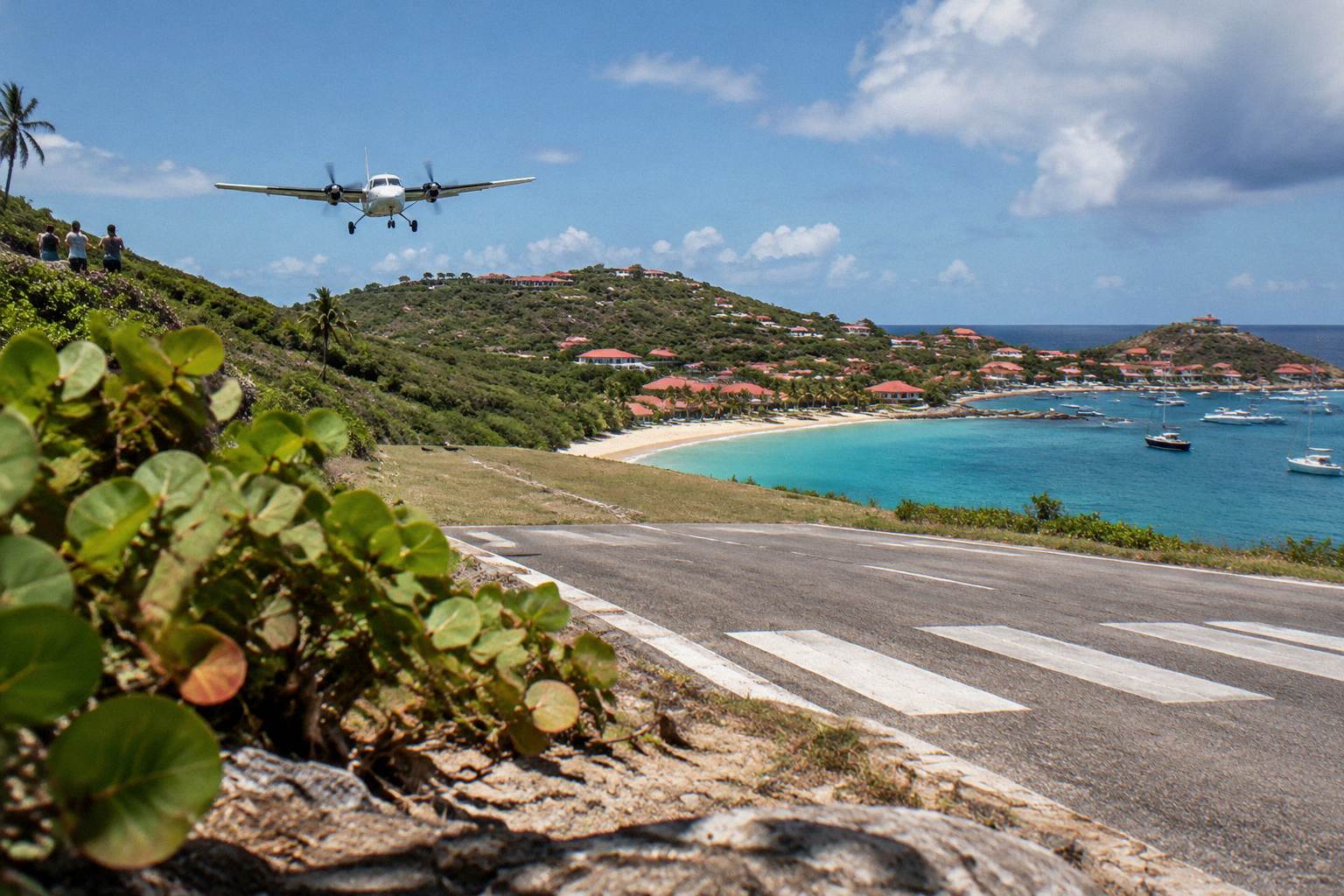
Tradewind Aviation To St Barts
Tradewind Aviation is one of the scheduled carriers that lands at St Barts' short-runway airport, flying Pilatus PC-12 turboprops from San Juan and Antigua. This guide explains the routes, the aircraft, the airport's limits, and how the service fits into a St Barthelemy trip.
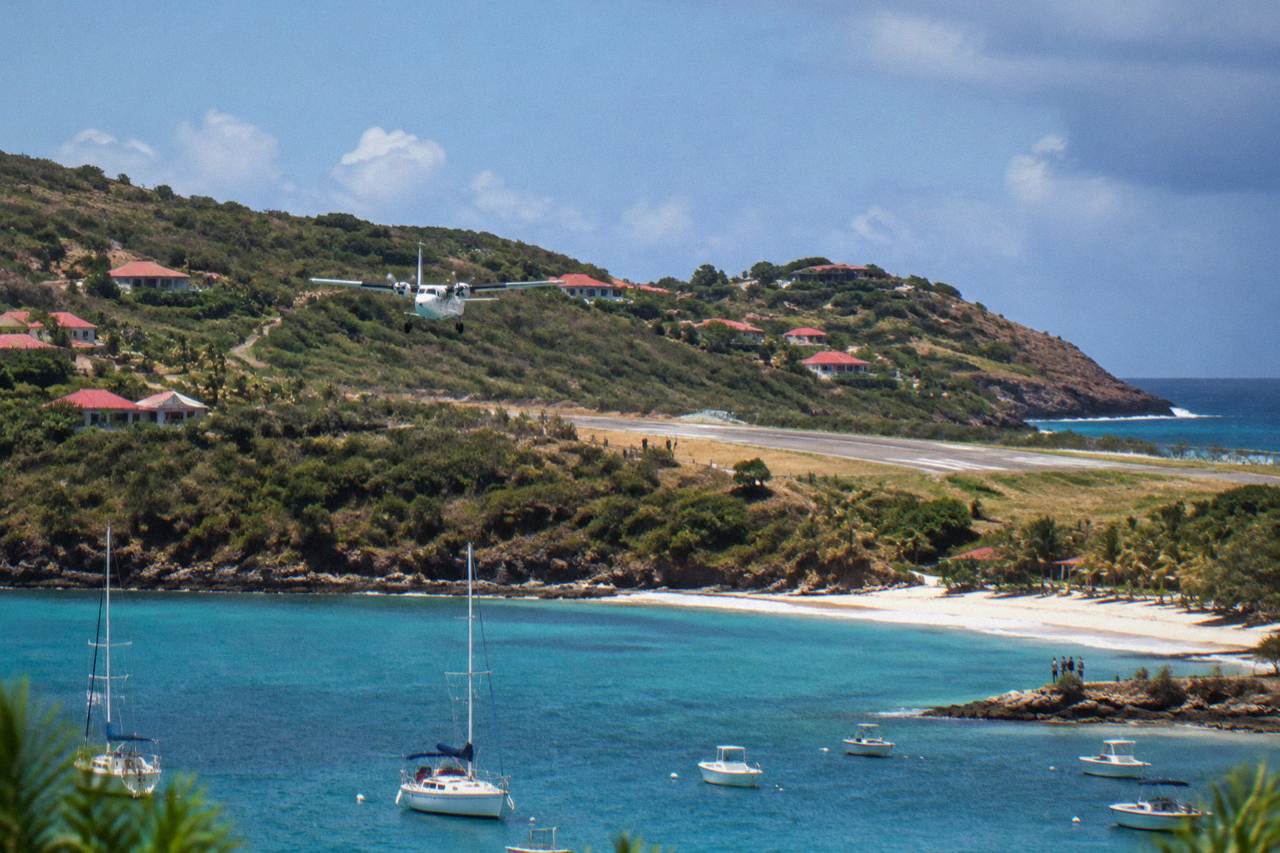
Tradewind Aviation flies scheduled Pilatus PC-12 services to Gustaf III Airport (SBH) on St Barts from San Juan, Puerto Rico (SJU) and Antigua (ANU), connecting travelers arriving on jets from the US mainland to the island's 646-meter runway, which accepts only small STOL turboprops in daylight conditions.
The airline operates scheduled Pilatus PC-12 turboprops into Gustaf III Airport (SBH) from San Juan, Puerto Rico and from Antigua, which makes it the main link between St Barts and the wider Caribbean flight network for travelers who do not want to connect through St Martin. This guide lays out what the service is, where it flies from, why the runway forbids jets, and how a Tradewind booking fits alongside the ferry, the St Martin hop and the island's boat tours. The basics of the wider journey are covered in the guide to getting to St Barts.
What Is Tradewind Aviation's Service To St Barts?
Tradewind Aviation is a US-based regional operator that runs scheduled passenger flights between the Caribbean and Gustaf III Airport on St Barts, using nine-seat Pilatus PC-12 turboprops, with San Juan and Antigua as its gateways to the island. Its service exists because St Barts' 646-meter runway accepts only small STOL aircraft, so every traveler arriving on a jet must change to a small plane somewhere. Tradewind's route network is built around exactly that change.
The PC-12 is the reason the airline can serve the island at all. The type is a pressurized single-engine turboprop with short-field performance, which suits a runway of 646 meters, or 2,119 feet, tucked below a hill at the edge of Gustavia harbor. Operations at SBH are limited to daylight and visual conditions, a constraint that shapes every schedule into the island regardless of carrier. The airport itself, its codes and its famous approach are covered in detail in the St Barts airport guide and the page on the airport code SBH.
For planning purposes, think of Tradewind as the carrier that answers one specific question: how do you reach St Barts if your long-haul flight lands in San Juan or Antigua rather than St Martin? The answer it gives is a direct small-plane hop instead of a second connecting flight to SXM followed by a third leg or a ferry crossing. Travelers coming from the US mainland can read the broader routing options in the guide to flying to St Barts from the US.
| Gateway airport | Code | Carrier serving St Barts | Aircraft type |
|---|---|---|---|
| San Juan, Puerto Rico | SJU | Tradewind | Pilatus PC-12 |
| Antigua | ANU | Tradewind | Pilatus PC-12 |
| Princess Juliana, Sint Maarten | SXM | St Barth Commuter, Winair | Cessna 208B, Twin Otter |
| Grand Case, St Martin | SFG | St Barth Commuter | Cessna 208B |
| Pointe-a-Pitre, Guadeloupe | PTP | St Barth Commuter | Cessna 208B |
Where Does Tradewind Aviation Fly From To Reach St Barts?
Tradewind's scheduled St Barts service departs from San Juan, Puerto Rico (SJU) and from Antigua (ANU), the two gateways where its PC-12s meet arriving jets from North America and Europe. Travelers whose long flights land at St Martin (SXM), Grand Case (SFG) or Guadeloupe (PTP) instead connect with St Barth Commuter or Winair rather than Tradewind.
San Juan is the significant gateway of the two. It is a major hub for flights from the US mainland, and Tradewind's presence there means a traveler can step off a jet from Miami or New York and board a PC-12 for St Barts without backtracking through St Martin. The dedicated page on flights from San Juan to St Barts covers that routing in depth. Antigua works the same way for travelers arriving from Europe or other Caribbean islands on that side of the Leewards.
No jet reaches St Barts from anywhere. The runway at SBH is 646 meters long, and the airport handles only small STOL turboprops in daylight, visual conditions. That single fact organizes the entire regional flight map: jets land at SXM, SJU, PTP or ANU, and the final leg is always a small aircraft or a ferry. The flights to St Barts guide lists the full set of feeder combinations.
It is worth being precise about what Tradewind is not. It is not the St Martin shuttle. That role belongs to St Barth Commuter flying from SXM, SFG and PTP, and to Winair with its Twin Otters at SXM, a carrier profiled on the Winair St Barts page. Tradewind's lanes are the longer ones from San Juan and Antigua, and its schedules are published and bookable well in advance, with service running year-round and capacity rising in the winter high season.
After landing, plenty of visitors add a day on the water, and several of the boat options listed here, which all depart from St Martin or Sint Maarten, can be combined with a Tradewind arrival. The trio below shows the range, from a per-person group sail to private charters.
Why Can't Jets Land At St Barts, And Why Can Tradewind's Planes?
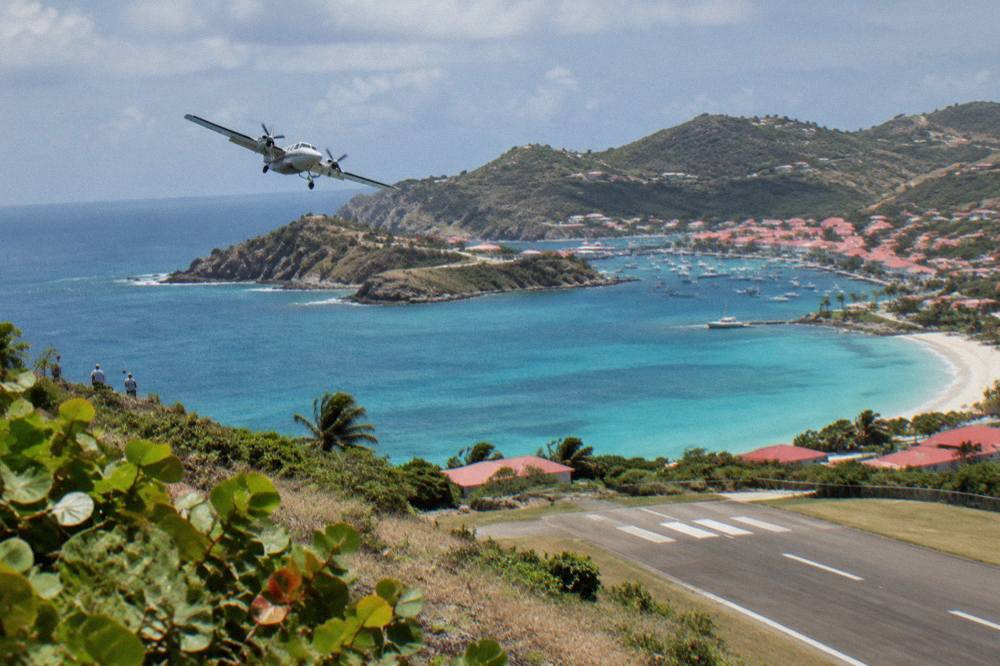
Jets cannot land at St Barts because the runway at Gustaf III Airport is only 646 meters, or 2,119 feet, long, and it sits at the base of a hill requiring a steep, specially certified approach, with operations restricted to daylight and visual conditions. Tradewind's Pilatus PC-12 aircraft are STOL types built for exactly this kind of short, demanding strip, and their pilots hold the qualification the airport requires.
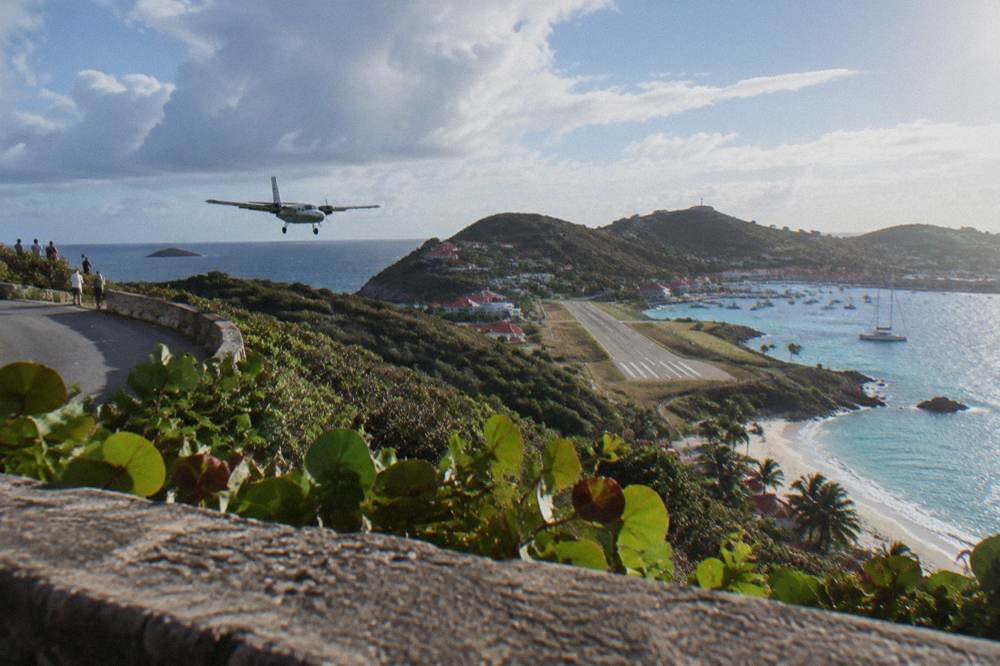
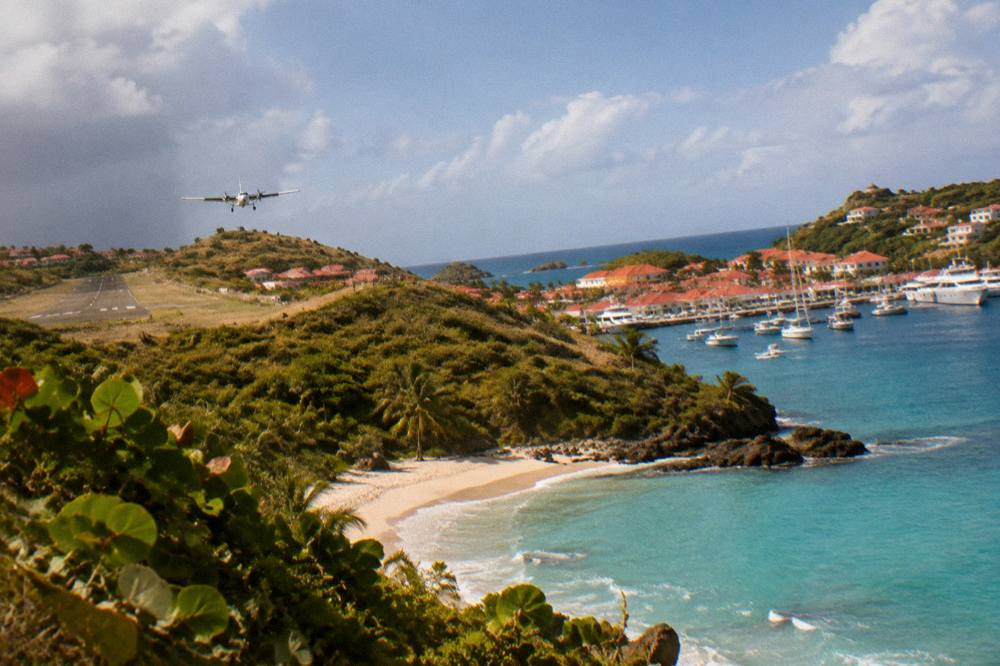
The geography is the story. The approach to runway 10 descends over a saddle of land, the Col de la Tourmente, and pilots must lose altitude quickly, level off over the road at the crest and touch down early on a runway with little margin. Only STOL-certified aircraft such as the PC-12, the Twin Otter and the Cessna 208B are operated there, and the airport closes at night because there is no runway lighting. The famous descent is described from the passenger's point of view in the guide to landing at St Barts airport.
| Gustaf III Airport fact | Detail |
|---|---|
| Airport name | Gustaf III, also called Remy de Haenen |
| Codes | SBH, ICAO TFFJ |
| Runway | 10/28, 646 m, 2,119 ft |
| Aircraft accepted | Small STOL turboprops only |
| Jet operations | None, no jet can use the runway |
| Operating hours | Daylight, visual conditions only |
| Location | Edge of Gustavia harbor, St Barts |
For a Tradewind passenger this means two practical things. First, the flight is weather-dependent in a way a jet flight is not: low cloud over the approach hill can delay or divert a landing. Second, the aircraft is small, so the whole experience, from the terminal at San Juan to the ramp at Gustavia, runs at a different scale from a mainline flight. The trade-off for that inconvenience is landing on an island roughly 21 square kilometres in size with about 10,700 residents, an island described further in this site's overview of things to do in St Barts.
How Does Booking A Tradewind Flight To St Barts Work?
Tradewind sells seats on its scheduled services directly and through its own booking system, with flights published well in advance across the season, and it also offers charter arrangements on the same PC-12 aircraft. Because every seat is on a nine-seat turboprop, availability moves in small increments, and schedules firm up further ahead than a ferry timetable does. The operator's live listing shows fares.
Booking early matters more here than on a mainline route, simply because a full flight is nine seats gone. That is also the appeal. Check-in is quick, the aircraft boards from the ramp, and the flight itself is the kind of short hop in which the pilot points at the islands below. Travelers connecting from a US arrival should build buffer into the connection at San Juan, since the St Barts leg only operates in daylight and the last departures follow the sun.
Baggage deserves a note, though this page prints no airline rule: small aircraft have strict weight and size limits, and the operator's own pages carry the current allowances. Packing light is the standard advice for any St Barts flight, whichever carrier flies it, and the site's packing guidance for the island reflects the same small-plane reality.
A practical pattern many trips follow is to fly Tradewind in and return, or arrive, via the ferry from St Martin, which is covered in the page on ferry operators and schedules. That page profiles Great Bay Express from Philipsburg and Voyager from Marigot, the two current scheduled ferry operators on the corridor, both crossing to Gustavia in roughly 45 to 60 minutes depending on operator and conditions.
What Is The Flight On A Tradewind PC-12 To St Barts Like?
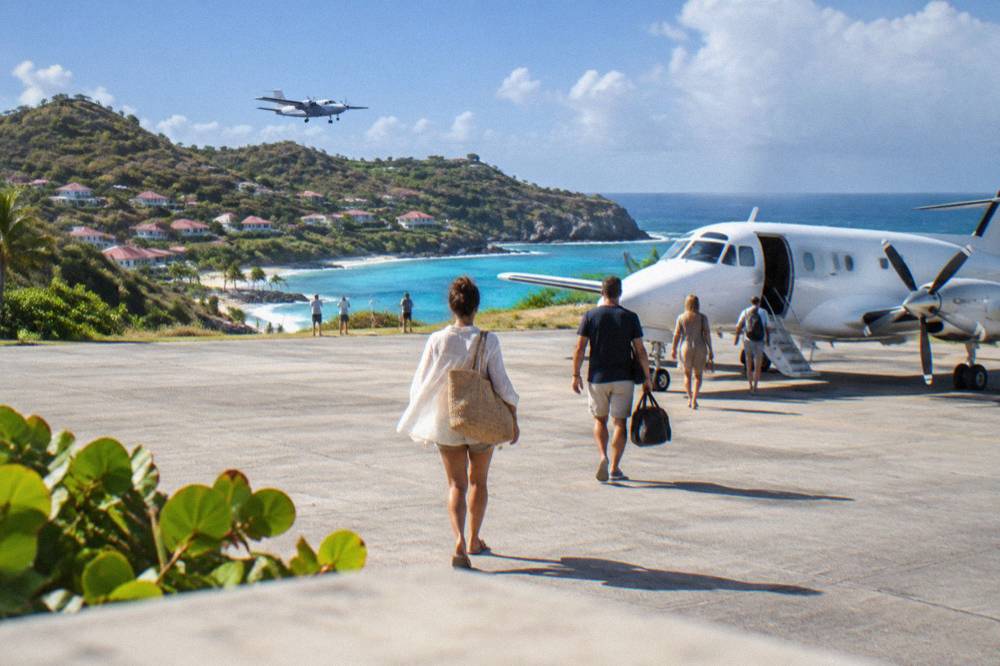
A Tradewind flight to St Barts is a low-altitude hop over the Leeward Islands in a pressurized nine-seat turboprop, ending with the certified steep approach over the Col de la Tourmente and a short-field touchdown at Gustavia, all in daylight. The cabin is small, the views are of islands and open water, and the landing at SBH is the part travelers remember.
The PC-12 cabin seats its passengers in a single arrangement with everyone close to a window, and the cruising altitude on these sectors keeps the Caribbean chain visible below for much of the trip. From San Juan the routing crosses the Virgins and the Leewards; from Antigua it hops down the same chain in the other direction. Both sectors are regional hops rather than long hauls. Everything else covered here is indexed on St Barthelemy Travel.
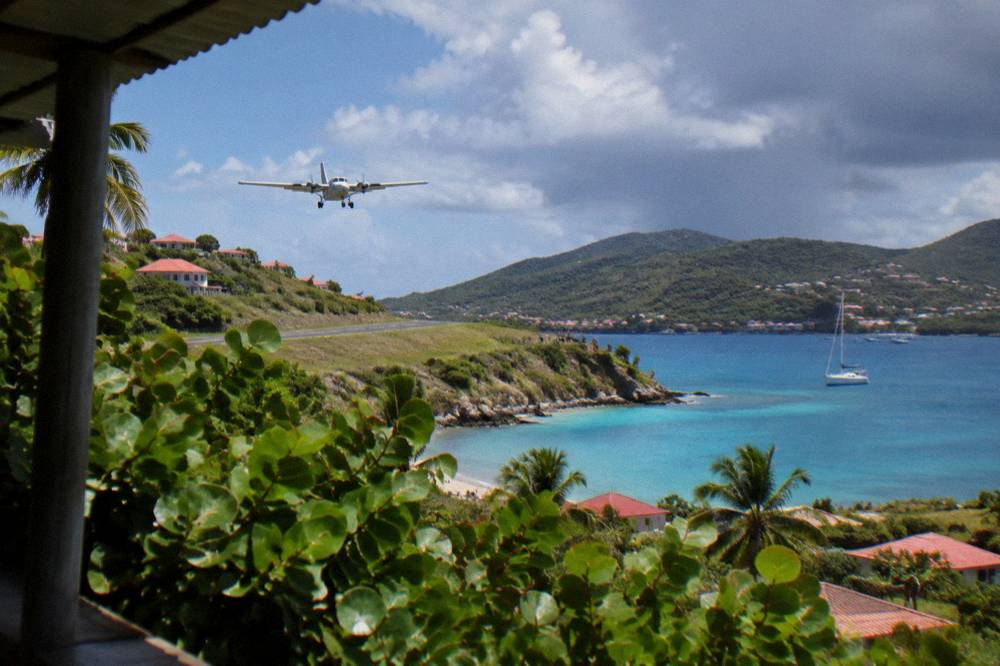
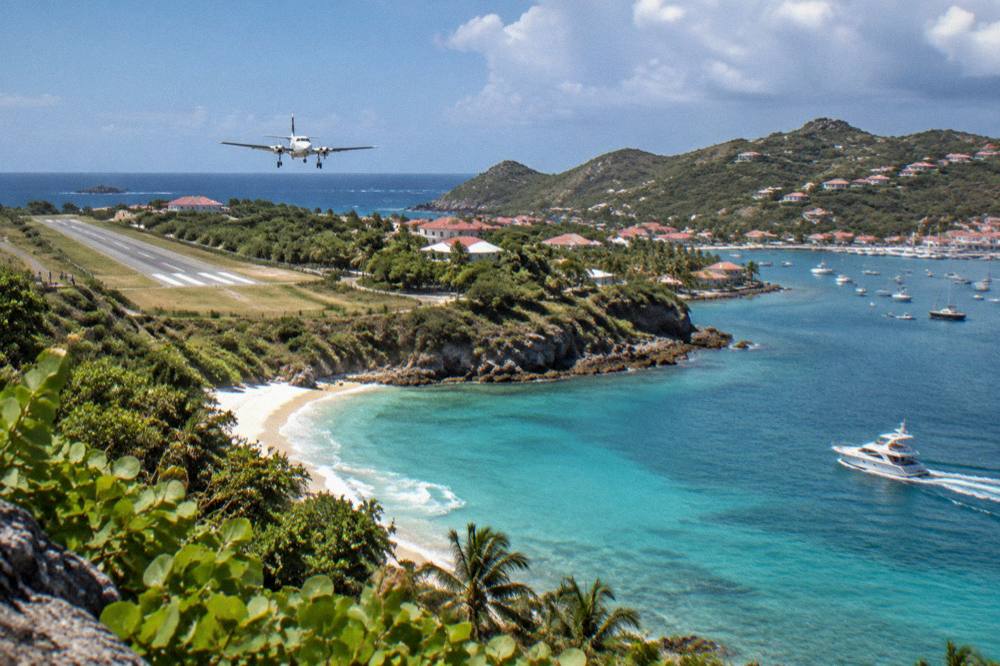
The descent is the famous part. The aircraft crosses the hill above St Jean, drops steeply over the road at the crest and touches down near the runway threshold with the beach of St Jean on one side and Gustavia's harbor on the other. The village of Corossol sits just off the approach. Passengers disembark onto a small apron a few steps from one of the smallest commercial terminals anywhere, and the harbor town of Gustavia is close enough that the walk into it is a realistic option with light luggage.
Tradewind Or The Alternatives: How Do The Routes To St Barts Compare?
Tradewind's strengths are its direct San Juan and Antigua links, which avoid a second connection through St Martin, while the alternatives trade that convenience for different balances: the St Martin hop is the shortest small-plane sector, the ferry from Philipsburg or Marigot is the sea option at roughly 45 to 60 minutes, and cruise calls tender into Gustavia without docking. None of these alternatives involves a jet at St Barts itself, because none can.
The comparison is really about where your long flight lands. If it lands at San Juan, Tradewind is the direct answer. If it lands at SXM, the choice is between the short hop on St Barth Commuter or Winair and the ferry, and the page on SXM airport to the St Barts ferry walks through that decision. If your trip is a cruise, the ship anchors offshore and you tender in, a process described in the St Barts cruise port guide.
Once you know where your jet touches down, book a flight to St Barts.
| Route to St Barts | From | Carrier or operator | Character |
|---|---|---|---|
| Scheduled PC-12 | San Juan (SJU) | Tradewind | Direct link from a major US-facing hub |
| Scheduled PC-12 | Antigua (ANU) | Tradewind | Direct link from an eastern gateway |
| Scheduled hop | SXM, SFG, PTP | St Barth Commuter, Winair | Short feeder legs from St Martin and Guadeloupe |
| Scheduled ferry | Philipsburg | Great Bay Express | Roughly 45 minutes, Bobby's Marina |
| Scheduled ferry | Marigot | Voyager | Roughly 50 to 60 minutes |
| Cruise tender | Offshore Gustavia | Cruise line tenders | No pier, ships anchor and tender |
The ferry deserves its own word of honesty: the crossing can be rough, and no source worth quoting promises a smooth one. Weather cancels ferry sailings and delays small-plane landings alike, which is the deeper reason to keep a flexible margin around any St Barts arrival. The island's weather and climate page explains the seasonal pattern behind that.
For travelers whose real interest is the water rather than the arrival, the boat products below round out the picture: a private day charter and a per-person group sail, each departing from St Martin or Sint Maarten.
When Is The Best Season To Fly Tradewind To St Barts?
The November to April window is the high season for flights into St Barts, with the most capacity and the island's principal events, while May to August is quieter on the ground and the September to October stretch overlaps the peak of the hurricane season, which runs 1 June to 30 November with its statistical peak near 10 September. Tradewind's schedules rise and fall with that pattern, as do the ferries.
The climate numbers behind the calendar come from the Meteo-France normals, 1991-2020, for the St Barthelemy station. The mean daily high runs from 28.5 C in January to 31.7 C in September, and the island receives 891.3 mm of rain across the year, with October the wettest month at 135.6 mm and February at the other end at 38.4 mm. The sea stays warm throughout, about 26 C in winter to about 29 C from August to October.
| Month | Mean daily high (C) | Mean daily low (C) | Rain (mm) |
|---|---|---|---|
| January | 28.5 | 23.5 | 52.6 |
| February | 28.6 | 23.3 | 38.4 |
| April | 29.8 | 24.2 | 50.9 |
| July | 31.2 | 26.0 | 80.4 |
| September | 31.7 | 26.2 | 96.9 |
| October | 31.4 | 25.8 | 135.6 |
The event calendar leans hard into the high season. The St Barth Music Festival runs 8 to 18 January 2027 for its 43rd edition, the Bucket Regatta falls in mid-March, and the Gourmet Festival runs 9 to 15 November 2026. Les Voiles de St Barth and the Film Festival sit in the April to early May stretch, with their 2027 dates unconfirmed. New Year's Eve is the island's famous peak, covered in the St Barts New Year's Eve guide. One seasonal nuance matters for flyers: many hotels and restaurants close each autumn and reopen between mid-October and early November, so a Tradewind seat in early October can land on a quieter island than the same seat in late October.
What Can You Do Once Tradewind Lands You In St Barts?
Once a Tradewind flight lands at Gustavia, the island opens up on a small and walkable scale: Gustavia's harbor, Shell Beach and the public beaches from Flamands to Grand Cul-de-Sac are all within a short drive on narrow, steep roads, and boat tours departing from St Martin circle the island's coast, including Colombier Beach and Ile Fourchue inside the marine reserve. All of the island's beaches are public.
The practical first decision is ground transport. Roads are narrow, winding and hilly, driving is on the right, and the speed limit is 50 km/h island-wide with 30 km/h in Gustavia and St Jean, so many visitors book a rental car or a Mini Moke, a choice unpacked in the St Barts car rental guide. Taxis exist, and the ferry terminal and airport are both close to the harbor.
The marine reserve frames the water side. The environment agency's regulatory-zones page lists a 5-knot speed limit in its zones, a ban on jet skis, 23 dive sites and a rule against touching turtles, and dogs are not allowed on the beaches under a municipal order that applies island-wide. Colombier Bay and Ile Fourchue sit inside the reserve, which is why the boat trips that visit them follow fixed anchoring rules there.
This site's featured boat day, the Gustavia, Colombier Beach and Ile Fourchue tour, departs from St Martin or Sint Maarten and spends its day on exactly that reserve coastline, with per-person seats that suit solo travelers and couples. It is described in full on its own tour page, and See the operator's live listing if a flight-and-sail combination appeals.
Where Do You Stay After A Tradewind Arrival In St Barts?
Accommodation on St Barts splits between hotels concentrated around Gustavia, St Jean, Flamands and Grand Cul-de-Sac, and a large villa market spread through the island's hills, with WIMCO, Sibarth and St Barth Properties named as established villa managers. Rates vary by season and each property's own booking page shows them.
The hotel landscape is dominated by well-known properties: Eden Rock and Cheval Blanc on St Jean and Flamands, Le Toiny on the Toiny coast, Le Sereno and the Guanahani side of Grand Cul-de-Sac, and Christopher at Pointe Milou. Several close each autumn and reopen between mid-October and early November, a pattern rather than a fixed notice, and the Rosewood-managed Guanahani becomes Airelles Le Guanahani on 1 November 2026. Full profiles sit in the guides to St Barts hotels and luxury hotels in St Barts.
| Stay type | Where it sits | Season note |
|---|---|---|
| Harbor hotels | Gustavia | Walkable from the ferry and close to the airport |
| Beach hotels | St Jean, Flamands, Grand Cul-de-Sac | Many close in autumn, reopening mid-October to early November |
| Hill villas | Vitet, Devet, Pointe Milou, Toiny | Available year-round through villa managers |
| Small guesthouses | Lorient, Corossol, Anse des Cayes | Limited number, book early in high season |
Villas are the alternative for groups and longer stays, and the comparison is drawn out in this site's guide to the villa market. For a traveler flying Tradewind, one detail matters: light aircraft baggage limits favor villa guests who can arrange groceries and beach gear on the island, which several villa managers organize as part of a booking.
What Should You Know Before Choosing Tradewind For St Barts?
Before booking Tradewind, know four things: the flight only operates in daylight and visual conditions, so weather can shift your arrival day; the aircraft is a nine-seat PC-12, so seats and baggage space are limited; the service connects from San Juan and Antigua, so your long-haul flight should land at one of those gateways; and the island you land on is small, about 21 square kilometres, with all beaches public and a marine reserve governing the water.
Each of those four has a ripple effect. Daylight-only operations mean early flights are safer bets than late ones when the schedule offers a choice. Small aircraft mean the packing list should match the baggage rules on the operator's own pages. The gateway choice means the San Juan route pairs naturally with flights from the US mainland, a pairing explored in the guides to flights from Miami and flights from New York. And the island's scale means a single week comfortably covers its main sights, as the site's itineraries demonstrate.
One final note on the arrival itself. Gustavia harbor, where the ferries dock and the cruise tenders land, sits minutes from the airport by taxi, and the town's shops and the surrounding forts Karl and Gustaf make an easy first afternoon. The St Barts shopping guide covers what the harbor boutiques actually stock, and the St Barts weddings page explains why so many couples fly in for ceremonies on those same public beaches.
For travelers who want the water as much as the arrival, the three products below cover the range of boat days listed here, from per-person sailing to private and overnight charters, every one of them departing from St Martin or Sint Maarten.
Common Questions About Tradewind Aviation St Barts
Does Tradewind Aviation fly direct to St Barts?
Tradewind flies scheduled direct services to Gustaf III Airport (SBH) on St Barts from San Juan, Puerto Rico and from Antigua. No jet and no flight from outside the Caribbean lands on the island itself, because the 646-meter runway accepts only small STOL turboprops.
What plane does Tradewind use for St Barts?
Tradewind operates the Pilatus PC-12, a pressurized single-engine turboprop with short-field performance suited to St Barts' 646-meter runway and its steep approach over the Col de la Tourmente.
Can you fly to St Barts without going through St Martin?
Yes. Tradewind's services from San Juan and Antigua reach St Barts without a St Martin connection, and St Barth Commuter also flies from Grand Case on the French side and from Guadeloupe. The St Martin hubs remain the busiest feeders, but they are not the only route.
Why do no jets land at St Barts?
The runway at Gustaf III Airport is 646 meters, or 2,119 feet, long, far too short for any jet, and the approach descends steeply over terrain with operations limited to daylight and visual conditions. Only STOL-certified turboprops are flown there.
Is Tradewind or the ferry better for reaching St Barts?
They answer different itineraries. Tradewind suits travelers whose long flights land at San Juan or Antigua. The ferries, Great Bay Express from Philipsburg and Voyager from Marigot, roughly 45 to 60 minutes across, suit travelers already on St Martin or Sint Maarten. The crossing can be rough.
When should I book a Tradewind flight to St Barts?
Book as early as your dates allow, especially for the November to April high season and the New Year period, because each flight carries only a handful of seats on a nine-seat aircraft. Schedules are published and bookable well in advance, so the operator's live listing shows current availability.