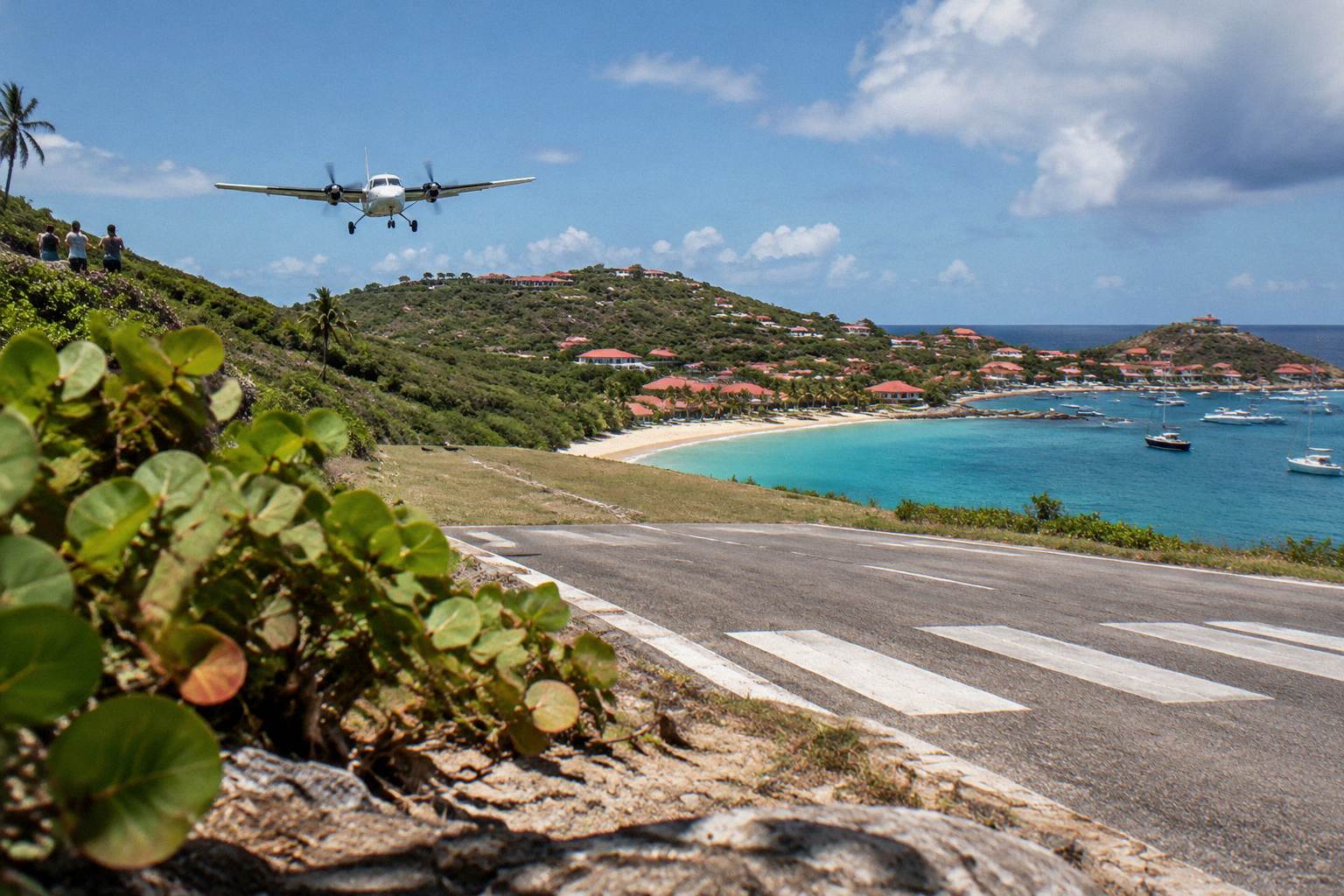
San Juan To St Barts: How The Flight Connection Works
San Juan to St Barts runs on small turboprops, because the island's 646 m runway at Gustaf III Airport accepts nothing larger. Tradewind Aviation flies the route from San Juan directly, and the island is otherwise reached through St Martin.
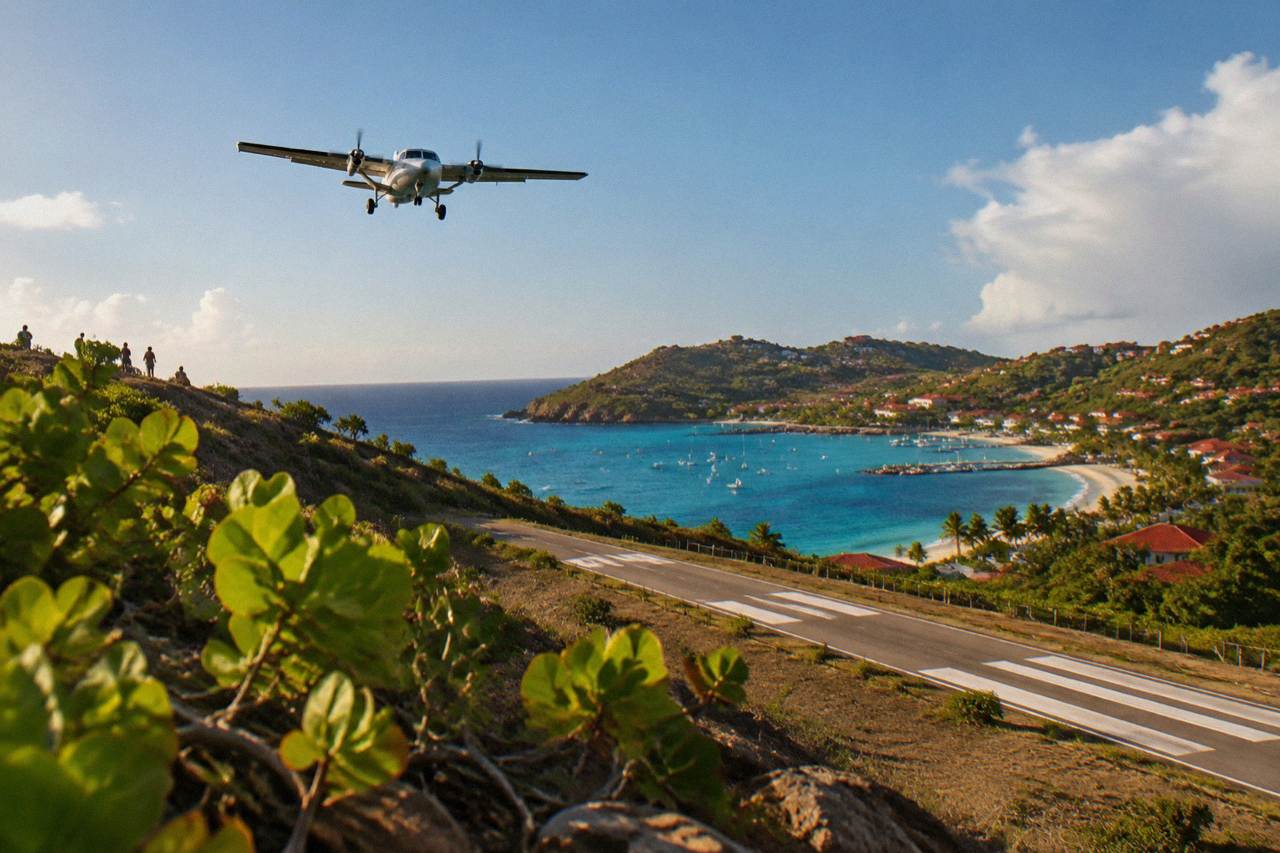
San Juan (SJU) is one of the gateways to St Barts: Tradewind Aviation flies directly to Gustaf III Airport (SBH) using Pilatus PC-12 turboprops, because the 646 m runway accepts only small STOL aircraft in daylight, visual conditions. Alternatives run through St Martin (SXM), Guadeloupe (PTP) or Antigua (ANU).
San Juan to St Barts is one of the few Caribbean routings that reaches St Barthelemy, the small French island in the Caribbean, without changing islands twice. The reason the route is unusual is physical: Gustaf III Airport (code SBH), also called Remy de Haenen, has a runway just 646 m (2,119 ft) long, which means only small STOL turboprops can land, in daylight and visual conditions only. No jet lands on St Barts, and none ever has on that runway. So the San Juan to St Barts leg is flown by specialist carriers with the right aircraft and crews, and everything else about planning the trip flows from that single fact.
San Juan works as a gateway because Puerto Rico concentrates flights from the United States mainland. A traveller lands at Luis Munoz Marin International (SJU) on a jet, then switches to a Pilatus PC-12 or a Cessna 208B for the hop over the Leeward Islands chain to St Barts. The basics of that last leg, the airport at the end of it, and what to do if the San Juan connection does not fit your dates, are laid out below. For the broader picture, the how to get to St Barts guide covers every gateway, and the St Barts airport guide covers the arrival itself.
Who Flies San Juan To St Barts?
Tradewind Aviation is the carrier that flies scheduled service from San Juan (SJU) to St Barts (SBH), using Pilatus PC-12 turboprops, according to the operator's own destination page. St Barth Executive also serves the island, and its fleet includes Tecnam P2012 STOL aircraft. The route exists at all because SBH's 646 m runway accepts only small STOL types: no jet reaches the island from anywhere, and flights operate in daylight under visual conditions only.
The Pilatus PC-12 is a pressurized single-engine turboprop that needs very little runway, which suits a 646 m strip that pilots approach over terrain. The operator's destination page lists St Barts among its scheduled destinations, and schedules are published and bookable in advance, with availability shown on some routes through at least April 2027. Capacity on the route increases in the high season, roughly November to April.
A second operator, St Barth Executive, also flies to St Barts, and reporting on the carrier notes it operates Tecnam P2012 STOL aircraft alongside Pilatus PC-12s. Winair, the other name that comes up in connection with the island, is a Twin Otter operator whose services are centered on St Martin: this page prints no Winair route or frequency. The dedicated Winair in St Barts page treats that carrier separately.
| Carrier | Aircraft To St Barts | Gateway Airports | Status Per The Operator's Pages |
|---|---|---|---|
| Tradewind Aviation | Pilatus PC-12 | San Juan (SJU), Antigua (ANU) | Scheduled service listed to St Barts |
| St Barth Executive | Tecnam P2012 STOL, Pilatus PC-12 | Guadeloupe (PTP) and regional points | Scheduled and charter operations reported |
| St Barth Commuter | Cessna 208B Grand Caravan | St Martin (SXM), Grand Case (SFG), Guadeloupe (PTP) | Scheduled and charter service listed |
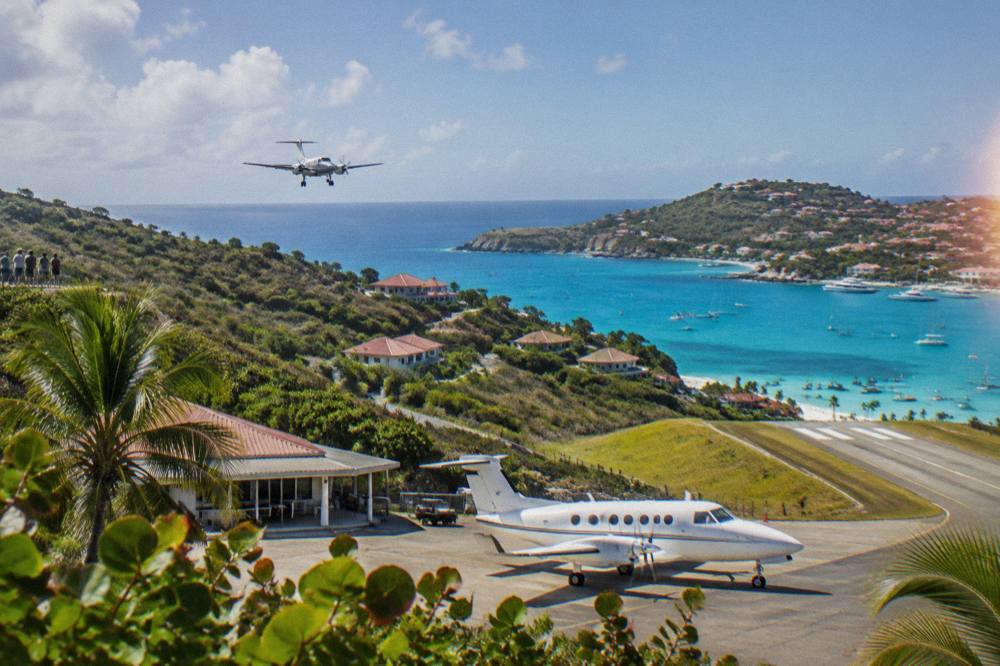
Why No Jet Flies From San Juan To St Barts?
The runway at Gustaf III Airport is 646 m (2,119 ft) long, and that physical limit means only STOL-certified turboprops such as the DHC-6 Twin Otter, the Cessna 208B Grand Caravan, the Pilatus PC-12 and the Tecnam P2012 can operate there. Operations are restricted to daylight and visual flight conditions, the airport has no runway lighting, and pilots need a special qualification for the approach. A jet from San Juan would simply be unable to stop in the distance available.
This is the single most useful fact for planning. Every journey to St Barts ends in a small airplane or a boat, no matter where it starts. A traveller flying from the US mainland crosses the Caribbean on a jet to a gateway, and the last leg from San Juan is flown low over the islands in a nine-seat-class turboprop. The approach over the Col de la Tourmente ridge and the short-field landing are famous among aviation enthusiasts, and the landing at St Barts airport page describes what that final descent involves.
The daylight restriction has a practical consequence worth building into any itinerary. The airport typically opens around 07:00 local and closes about 15 minutes after sunset. A late-evening jet arrival into San Juan cannot be followed by a St Barts leg the same night: the connection has to be overnighted in San Juan or moved to the morning. St Barts runs on Atlantic Standard Time, UTC minus 4, with no daylight saving shift, which removes one variable from the connection math.
| St Barts Airport Fact | Detail | Planning Consequence |
|---|---|---|
| Airport name and code | Gustaf III / Remy de Haenen, SBH (TFFJ) | The three letters on your ticket are SBH |
| Runway | 646 m (2,119 ft), single strip 10/28 | Only small STOL turboprops land |
| Operating hours | Opens about 07:00, closes about 15 minutes after sunset | No evening arrivals; overnight in the gateway if needed |
| Flight rules | Daylight, visual conditions only | Weather can divert or cancel the last leg |
| Aircraft types | PC-12, Cessna 208B, Twin Otter, Tecnam P2012 | Small cabins; baggage limits are set by the operator |
| Time zone | UTC minus 4, no daylight saving | Same clock year-round |
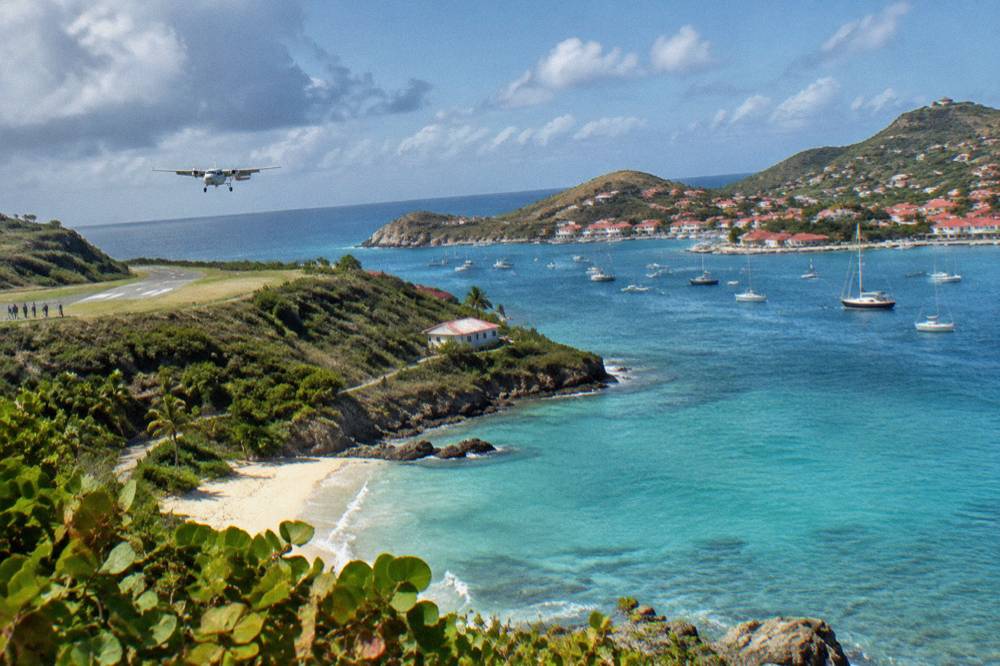
The island itself is small: about 21 square kilometres of hills and beaches, with roughly 10,700 residents, and Gustavia as its harbour capital. Arriving by air, the whole territory is visible in a single approach. The St Barts airport code page untangles the SBH and TFFJ designations if a booking site asks for one or the other.
Is San Juan The Best Gateway To St Barts From The United States?
San Juan is a strong gateway from the eastern United States because it concentrates mainland jet arrivals, but it is not the only one: St Martin (SXM) is the primary gateway overall, with the most onward seats to St Barts, and Guadeloupe (PTP) and Antigua (ANU) work for other routes. The right choice depends on where the trip starts, how the connection times line up, and whether the traveller prefers the ferry option that only St Martin offers.
St Martin deserves the comparison honestly. It sits 30-odd kilometres from St Barts and offers two onward modes: the small-plane hop, flown by St Barth Commuter from SXM, Grand Case and Pointe-a-Pitre, and the ferry from either Philipsburg (Great Bay Express, about 45 minutes) or Marigot (Voyager, about 50 to 60 minutes). Those "about" figures come from the operators, and the crossing can be rough; the page on St Barts ferry operators and the schedule covers both lines, and the SXM airport to St Barts ferry route covers the plane-to-boat change.
San Juan's advantage is directness from the mainland: a traveller can land at SJU and stay in one terminal system for the St Barts leg, with no border crossing into the French territory at the gateway. Its limitation is frequency: the St Martin corridor carries far more onward flights per day in season. Antigua (ANU) is served seasonally by Tradewind as well, per the operator's pages, and Guadeloupe (PTP) connects from the French side. The flights to St Barts overview and the flying to St Barts from the US guide lay out each of these in detail.
What Does The San Juan To St Barts Flight Feel Like?
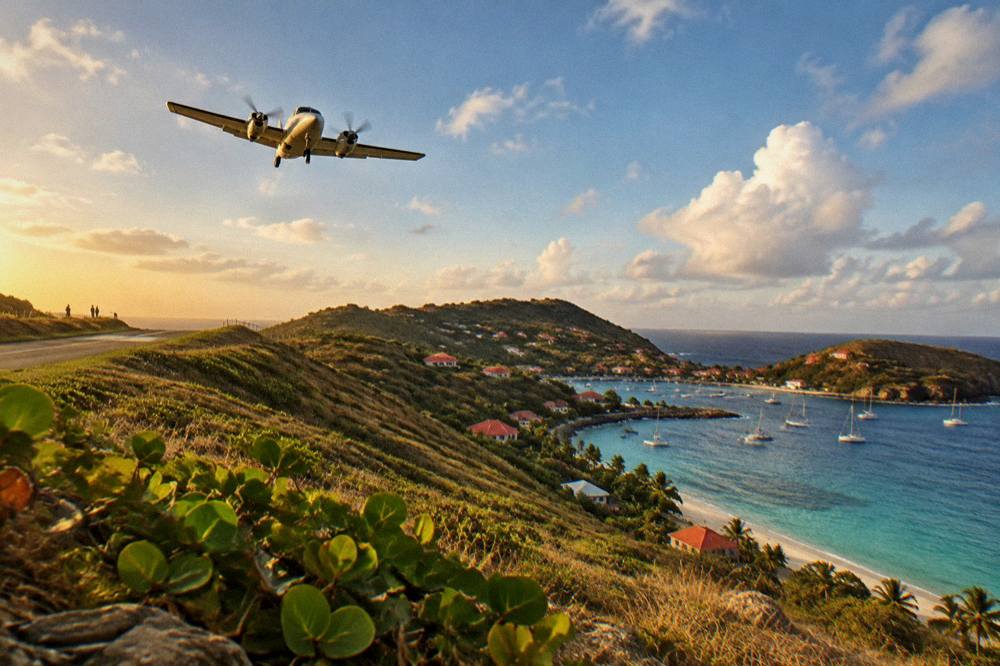
The leg is flown in a small pressurized or unpressurized turboprop at low altitude across the Leeward Islands chain, ending in the specialized approach over a ridge onto a 646 m strip beside the beach at Saint-Jean. The operators describe the service as scheduled shuttle flying rather than a charter experience, and passengers should expect a small cabin, a pilot in view, and baggage limits set by the aircraft type rather than by airline policy.
Reporting on the aircraft types gives the practical picture. The Pilatus PC-12 seats a small number of passengers in a cabin configured for short regional sectors. The Cessna 208B Grand Caravan and the DHC-6 Twin Otter are similar in scale. None of these aircraft takes a jet's worth of luggage: whatever allowance applies is published by the operator, and this page prints none of it. Soft bags rather than hard cases are the standard advice for this kind of flying.
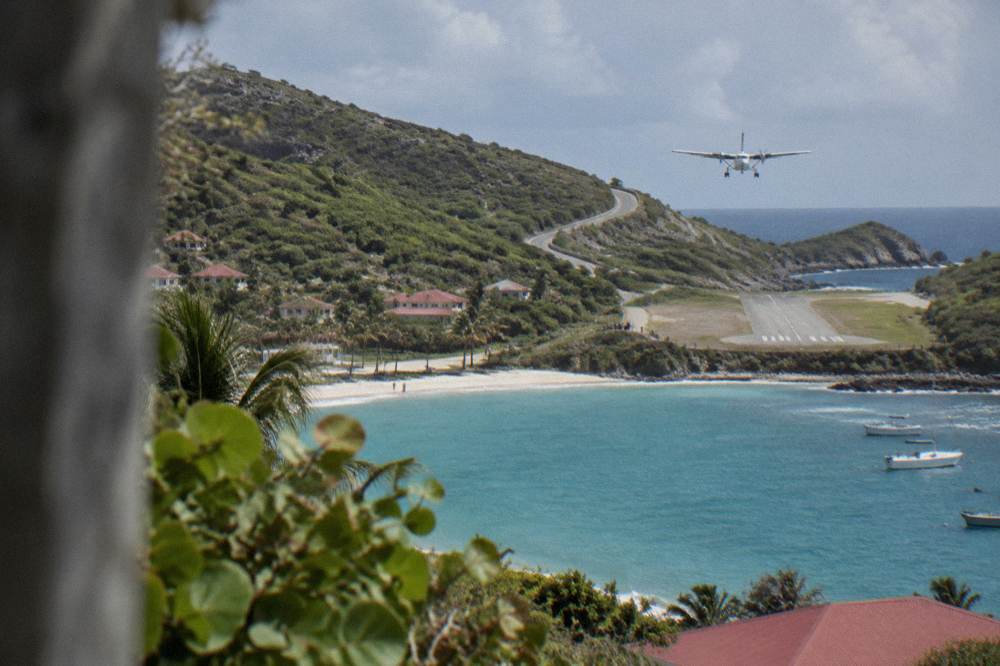
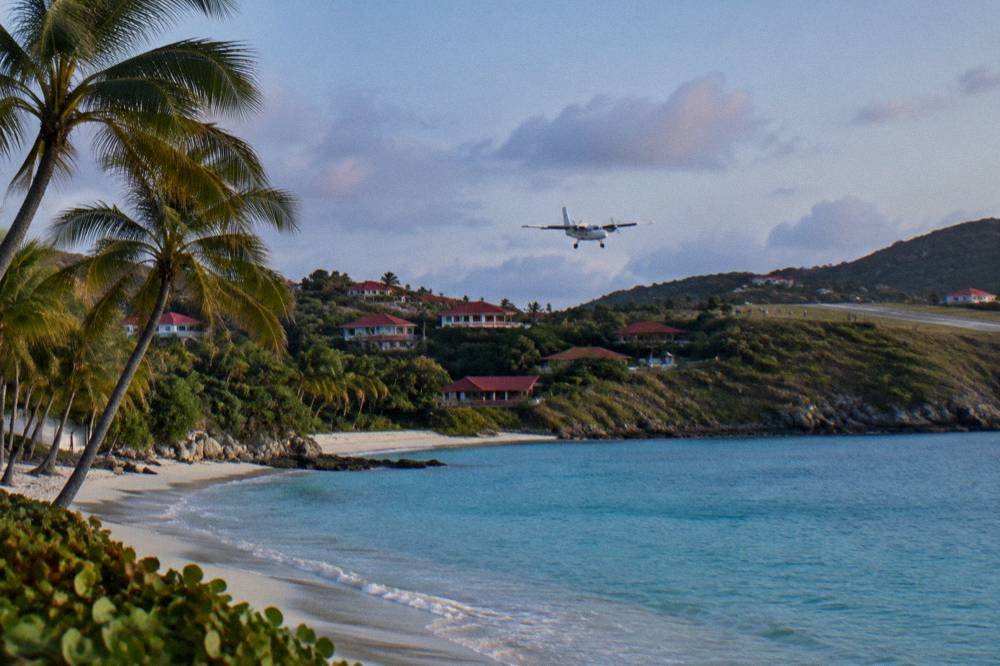
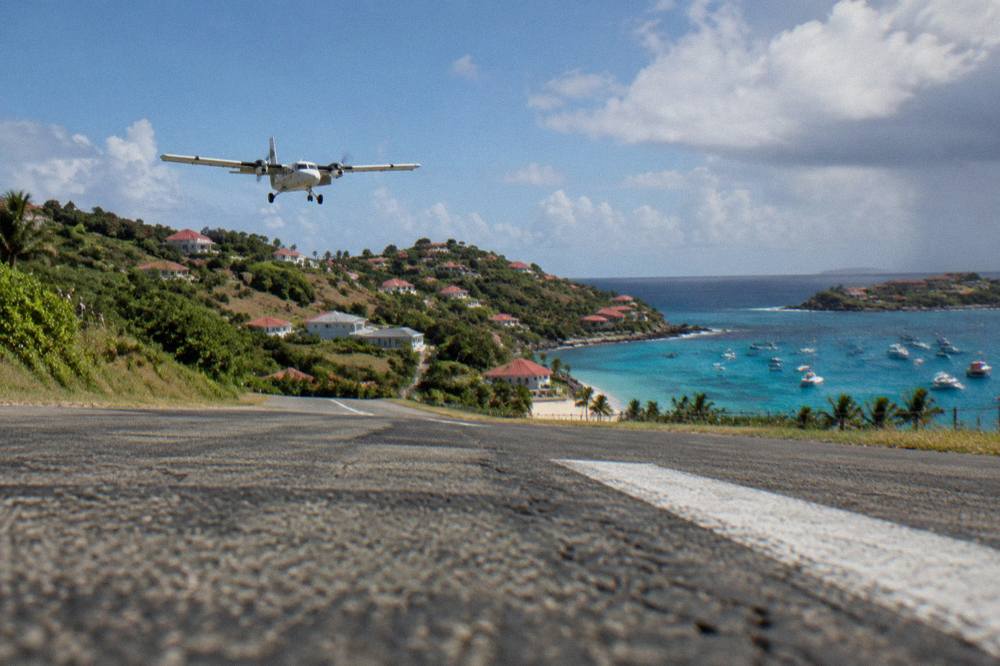
The approach is the part travellers remember. The published description of the airport notes the steep descent over the Col de la Tourmente and the short-field touchdown, with the runway terminating near the road and the beach at Saint-Jean. Pilots flying into SBH require special certification for the approach. Passengers sit through a descent that is steeper than a jet landing, then step out onto a small apron a minute later. There is no jet bridge, and there is no need for one.
When Should You Fly San Juan To St Barts?
The flight operates year-round with capacity increases in the high season from roughly November to April, and the planning windows that matter most are the daylight restriction on every single day, the autumn period when many island hotels close, and the Atlantic hurricane season from 1 June to 30 November, which peaks mid-August to mid-October. No month can be promised storm-free, and no prediction of weather or availability should be trusted from any source.
The Meteo-France normals, 1991-2020, for the St Barthelemy station show a mean daily high of 28.5 C in January rising to 31.7 C in September, with 891.3 mm of rain across the year and October the wettest month at 135.6 mm. The island is warm in every month, and the sea stays warm too, about 26 C in winter to about 29 C from August to October. Those figures describe the climate, not any specific week, and the weather on the day of a flight is a separate question governed by the visual-flight rules at SBH.
| Month | Mean Daily High (C) | Mean Daily Low (C) | Rain (mm), Meteo-France Normals 1991-2020 |
|---|---|---|---|
| January | 28.5 | 23.5 | 52.6 |
| February | 28.6 | 23.3 | 38.4 |
| March | 29.0 | 23.5 | 41.4 |
| April | 29.8 | 24.2 | 50.9 |
| May | 30.7 | 25.1 | 61.7 |
| June | 31.2 | 25.9 | 56.0 |
| July | 31.2 | 26.0 | 80.4 |
| August | 31.6 | 26.3 | 79.6 |
| September | 31.7 | 26.2 | 96.9 |
| October | 31.4 | 25.8 | 135.6 |
| November | 29.9 | 25.0 | 118.6 |
| December | 28.9 | 24.1 | 79.2 |
The seasonal pattern on the ground matters as much as the sky. Many hotels and restaurants on St Barts close each autumn and reopen in waves between mid-October and early November. A traveller who times a San Juan connection for late October or November finds the island coming back to life, with the Gourmet Festival running 9 to 15 November 2026. Villas, by contrast, generally remain available year-round, which makes them the reliable base in the shoulder months. The month-by-month implications are covered in the best time to go to St Barts season guide.
What If The San Juan Flight Does Not Work?
The fallback routes all pass through St Martin: fly SJU to SXM on any mainline jet operator, then take the short hop to St Barts on St Barth Commuter or the ferry from Philipsburg or Marigot, with Great Bay Express crossing in about 45 minutes and Voyager in about 50 to 60 minutes per the operators' own pages. Guadeloupe and Antigua serve as French-side and southern alternates. Every one of these options ends in the same small aircraft or the same boat.
St Martin is the gateway the island leans on, and the reason is geography plus frequency. The hop from St Martin to St Barts is a short one, flown several times a day in high season, and the ferry gives a second mode when the flights are full or weather-limited. The ferry terminals sit on opposite sides of the shared island: Great Bay Express leaves from Bobby's Marina in Philipsburg on the Dutch side, Sint Maarten, and Voyager leaves from the Marigot terminal on the French side, St Martin. A passport is required on both, and the operators ask passengers to check in well before departure.
| Route To St Barts | Mode | Operator Or Carrier | Notes From The Operators' Pages |
|---|---|---|---|
| San Juan (SJU) to SBH | Scheduled turboprop | Tradewind Aviation | Pilatus PC-12; capacity rises in season |
| St Martin (SXM) to SBH | Scheduled turboprop | St Barth Commuter | Cessna 208B; the busiest corridor |
| Guadeloupe (PTP) to SBH | Scheduled turboprop | St Barth Commuter, St Barth Executive | Serves French-side connections |
| Antigua (ANU) to SBH | Scheduled turboprop | Tradewind Aviation | Seasonal, more limited frequency |
| Philipsburg to Gustavia | Ferry | Great Bay Express | From Bobby's Marina; about 45 minutes |
| Marigot to Gustavia | Ferry | Voyager | From the Marigot terminal; about 50 to 60 minutes |
One caution belongs here: the Edge ferry that older guides list from Oyster Pond is not part of the current picture, and this page omits it because nothing verifiable supports it. The two operators above are the scheduled services the port and operator pages currently show. If a boat rather than a ferry appeals, the bookable private transfers and charters from St Martin are covered on the St Barts private boat transfer page, and all of them depart from St Martin or Sint Maarten, never from St Barts itself.
Do You Need A Passport For The San Juan To St Barts Route?
Yes: a valid passport is the standard document, because St Barts is a French overseas collectivity outside the Schengen area, and US travelers need a passport book rather than a passport card for the air legs. Visa-free stays of up to 90 days apply for US, UK, Canadian and EU citizens, an onward ticket is required, and exact passport-validity expectations differ by nationality, so each traveler should check their own government's current travel advice before booking.
The entry rules come from French authorities, and the practical details are reported rather than guaranteed: US government advice has referenced longer validity expectations, UK advice references three months beyond departure, and Canadian advice references validity for the stay. Because those positions differ, no single number of months applies. What is solid is the structure: the territory is outside Schengen, so the planned ETIAS and EES systems do not govern entry to St Barts, and ETIAS is not live. The St Barts passport and entry page and the customs and entry guide carry the details.
Two further entry facts are worth knowing on this route. First, a tourist tax applies and is collected through accommodations rather than at the border. Second, transit through San Juan means clearing US formalities there for US-bound travelers on the return, since Puerto Rico is a US territory. None of this is arduous, but it means the journey involves more document checks than a domestic flight, and the documents should be carried, not photographed.

How Do You Build A Day Around The Arrival?
Most arriving travelers collect a rental car at the airport, where Avis, Budget and Hertz hold counters and local agencies offer small cars and Mini Mokes, and then settle into the island's rhythm quickly because nowhere on St Barts is far from anywhere else: the island measures about 21 square kilometres, all beaches are public, and the driving is on the right with a 50 km/h island-wide limit and 30 km/h through Gustavia and St Jean.
The road network is narrow, winding and steep in places, which is why small vehicles with higher clearance are the common choice. Booking ahead is standard practice for the December to April period, and the St Barts car rental guide covers the counters, the vehicle types and the tips that matter. For anyone who would rather not drive at all, taxis serve the airport, and the island is small enough that a taxi-plus-feet plan is workable for a short stay.
The first afternoon writes itself. Gustavia's harbour and its shops are a few minutes from the airport, Shell Beach (Grand Galet) is within walking distance of town, and the beaches of Saint-Jean, Gouverneur and Saline are each a short drive on the island's roads. All beaches are public and free to access, which makes the arrival day easy to improvise. For a fuller first-day plan, the St Barts itinerary guide sequences the island sensibly.
| Arrival-Day Option | What It Involves | Where It Sits On The Island |
|---|---|---|
| Gustavia harbour and town | Red-roofed harbour capital, shops, historic forts Karl and Gustaf | West coast, minutes from the airport |
| Shell Beach (Grand Galet) | Public beach with shells, walking distance from Gustavia | South edge of Gustavia |
| Saint-Jean | Public beach beside the airport runway's beach end | North side of the airport |
| Gouverneur and Saline | Public beaches reached by winding roads over the hills | South coast |
| Grand Cul-de-Sac | Shallow bay on the sheltered northeast side | Northeast coast |
Can You Combine The Flight With A Boat Day From St Martin?
Every bookable boat tour that visits St Barts departs from St Martin or Sint Maarten, not from St Barts, so the realistic combination is a stay on St Martin before or after the St Barts visit: the group sail to Gustavia, Colombier and Ile Fourchue, the full-day and half-day private charters, and a two-day one-night catamaran all leave from the Dutch or French side of the shared island.
A traveler flying San Juan to St Barts can add the boat day by routing the return or the outbound through SXM with a night or two there.
The group sail listed here is the one per-person product among the boat trips, and its listing runs it only from 12 May to 31 August 2027, which places it in the low season rather than the winter peak. The rest of the trip list consists of private charters priced per group: a full-day private charter, a private charter from St Martin, a Nikki Beach private charter out of Sint Maarten, and the overnight catamaran. None of these can be picked up in Gustavia, and a page that says otherwise is wrong. The question of which island to base on is treated in the St Barts versus St Martin comparison and in St Maarten before or after St Barts.
The natural pairing, for a traveler already committed to the San Juan gateway, is to fly SJU to SBH, spend the stay on St Barts, then take the ferry or the small plane to St Martin for the boat day and a flight home from SXM. That order avoids backtracking, and it puts the rougher sea crossing, if any, on a day without a flight attached. Whether the sea cooperates is not promised by anyone: the operators themselves flag weather cancellations.
Where Should You Stay After Landing From San Juan?
The island's accommodation splits between hotels concentrated in Gustavia, Saint-Jean, Flamands and Grand Cul-de-Sac, and a large villa market managed by specialists such as WIMCO, Sibarth and St Barth Properties, with hotels closing in waves each autumn and reopening between mid-October and early November while villas generally stay available year-round; rates vary by season and each property's own booking page shows them.
The named hotel properties on this site's list include Eden Rock, Cheval Blanc, Le Toiny, Le Sereno, Hotel Manapany, the Christopher, Le Barthelemy and Le Village, among others, and the individual hotel pages under the guides section carry the details for each. For choosing between areas rather than properties, the best area to stay in St Barts guide and the Gustavia where to stay page break down the trade-offs: harbour proximity against beach proximity, walkability against car dependence.
The villa route suits the San Juan traveler particularly well in the shoulder months, because a late-October arrival can precede some hotel reopenings. The St Barts villas guide and the hotel versus villa comparison set out how the two models differ in practice. Names to know in villa management are WIMCO, Sibarth and St Barth Properties, listed here as managers only, with no claim about which is best.
What Can Go Wrong With The San Juan To St Barts Plan?
The three realistic failure points are the daylight-only rule at SBH, the visual-flight-conditions requirement, and the connection gap between a jet arrival into San Juan and the last turboprop departure of the afternoon; each has a standard fix, namely an overnight in San Juan or a reroute through St Martin, where the ferry adds a weather-independent-on-paper alternative that still depends on sea state. None of these risks is a reason to avoid the route, only reasons to build slack into the itinerary.
Weather is the honest variable. A morning that looks fine in San Juan can hold low cloud or wind over the final approach, and the flight rules at SBH do not permit instrument workarounds. The operators rebook passengers onto the next available departure, which is why the last-night-before-a-cruise-or-wedding pattern is a known trap: fly in a day early. Travelers heading to a St Barts wedding or timing an arrival against the New Year's Eve period, when the island is at its busiest, should treat the buffer day as part of the plan rather than a luxury.
The second variable is capacity. The route's seats are finite in any given week, and the December-to-April window fills first. Booking the San Juan leg and the St Barts leg together, with the gateway overnight if the timing demands it, removes the single-point-of-failure problem. And if everything sold out, the St Martin corridor with its higher flight frequency and two ferry operators remains the fallback that keeps the trip alive.
Common Questions About San Juan To St Barts Flights
Can you fly direct from San Juan to St Barts?
Yes, in the sense that Tradewind Aviation operates a scheduled service from San Juan (SJU) to St Barts (SBH) with no intermediate stop. It is flown by Pilatus PC-12 turboprops, not jets, because the runway at St Barts is 646 m long and accepts only small STOL aircraft.
Is there a nonstop jet from the US to St Barts?
No. No jet of any kind lands at St Barts. US travelers reach the island by flying a jet to a gateway such as San Juan, St Martin, Guadeloupe or Antigua, then connecting on a small turboprop or taking the ferry from St Martin.
How long is the flight from San Juan to St Barts?
The route is one of the longer scheduled hops into St Barts. The operator's booking pages show the scheduled duration for each departure, and times can vary with routing and weather.
What airlines fly into St Barts?
Per the operators' own pages, Tradewind Aviation flies from San Juan and Antigua, and St Barth Commuter flies from St Martin (SXM), Grand Case (SFG) and Pointe-a-Pitre, Guadeloupe (PTP). St Barth Executive also serves the island. Winair flies the SXM to SBH hop on Twin Otters.
Can I take a ferry from San Juan to St Barts?
No. The scheduled ferries to Gustavia run from St Martin and Sint Maarten only: Great Bay Express from Philipsburg and Voyager from Marigot. From San Juan the onward leg is by air, or by connecting through St Martin first.
Do flights to St Barts operate at night?
No. Gustaf III Airport operates in daylight and visual conditions only, typically opening around 07:00 and closing about 15 minutes after sunset. A late jet arrival into any gateway requires an overnight before the St Barts leg.
For everything the flight itself does not cover, St Barthelemy Travel carries the island end to end: the beaches, the areas, the itineraries and the day trips that make the short runway worth it.