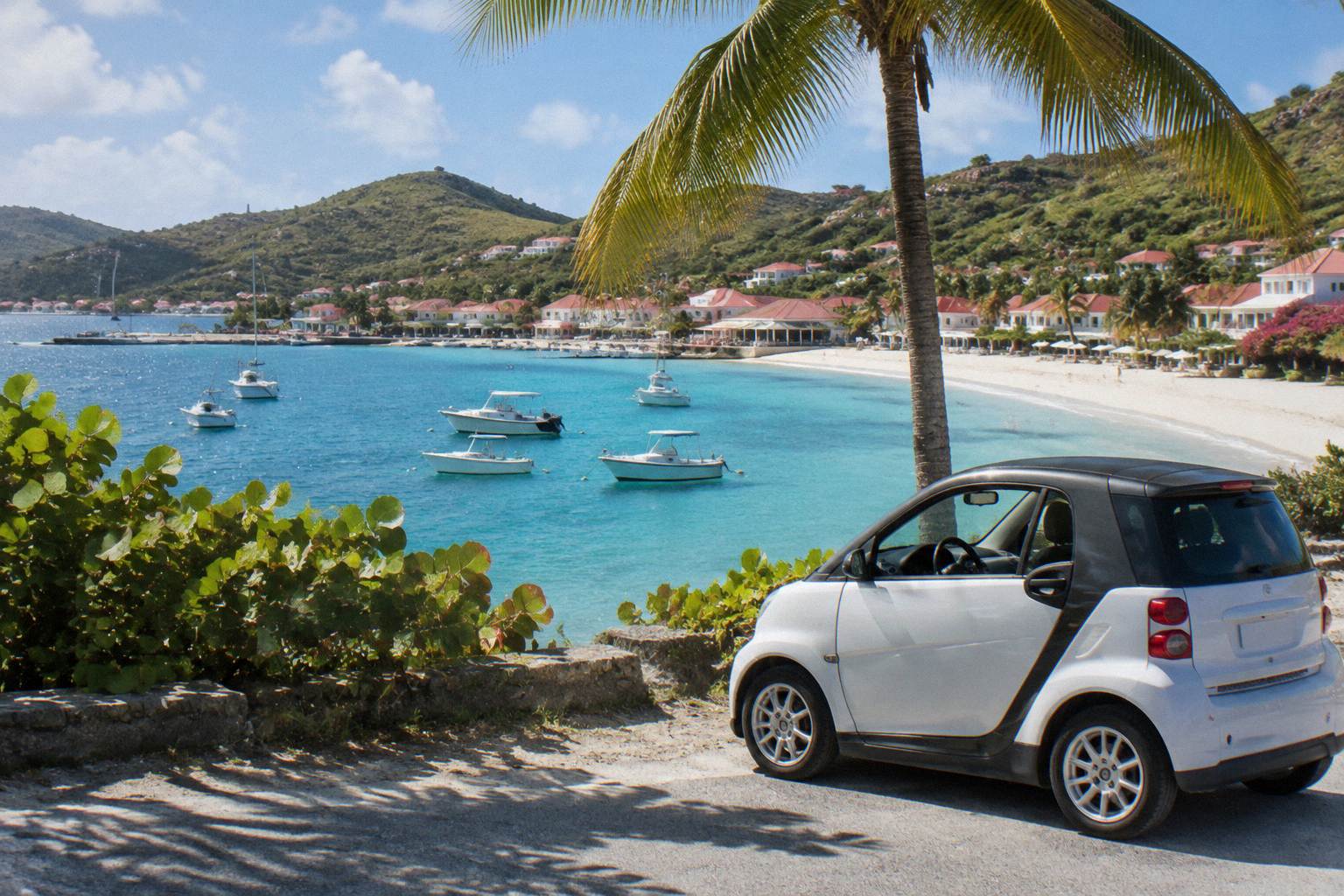
Renting A Mini Moke
The Mini Moke is the vehicle most associated with St Barts: a small open-air car built for narrow roads, sunshine and short hops between beaches. This guide covers what a Moke is, where to rent one on the island, the driving rules that apply, and how a Moke fits into a wider St Barts itinerary.
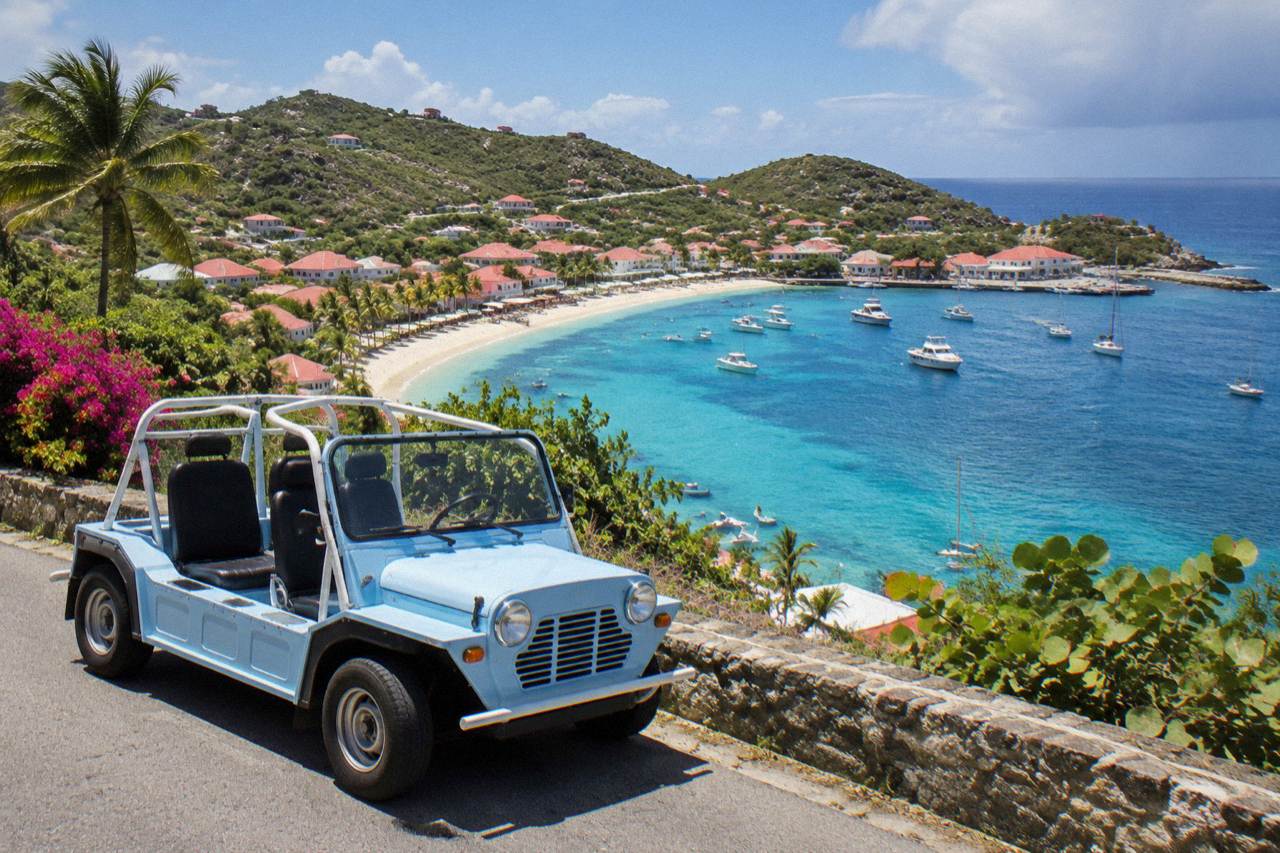
A Mini Moke in St Barts is a small open-top rental car offered by local agencies rather than the international brands; Avis, Budget and Hertz hold counters at Gustaf III Airport, while Mokes come from local operators. Driving is on the right, roads are narrow and steep, and the reported speed limits are 50 km/h island-wide and 30 km/h in Gustavia and Saint-Jean.
St Barthelemy, usually written St Barts, is a small French island in the Caribbean of about 21 square kilometres, and its road network reflects that scale: narrow, winding lanes that climb over hills between one beach and the next. The vehicle most associated with getting around it is the Mini Moke, the compact open-air car that appears in nearly every photograph of the island's roads. Renting one is straightforward, but the details matter, from which agencies actually supply Mokes to the rules that apply on roads this steep. This guide from St Barthelemy Travel covers what a Moke is, who rents them, what driving one involves, and how the choice fits the rest of a St Barts trip.
What Is A Mini Moke?
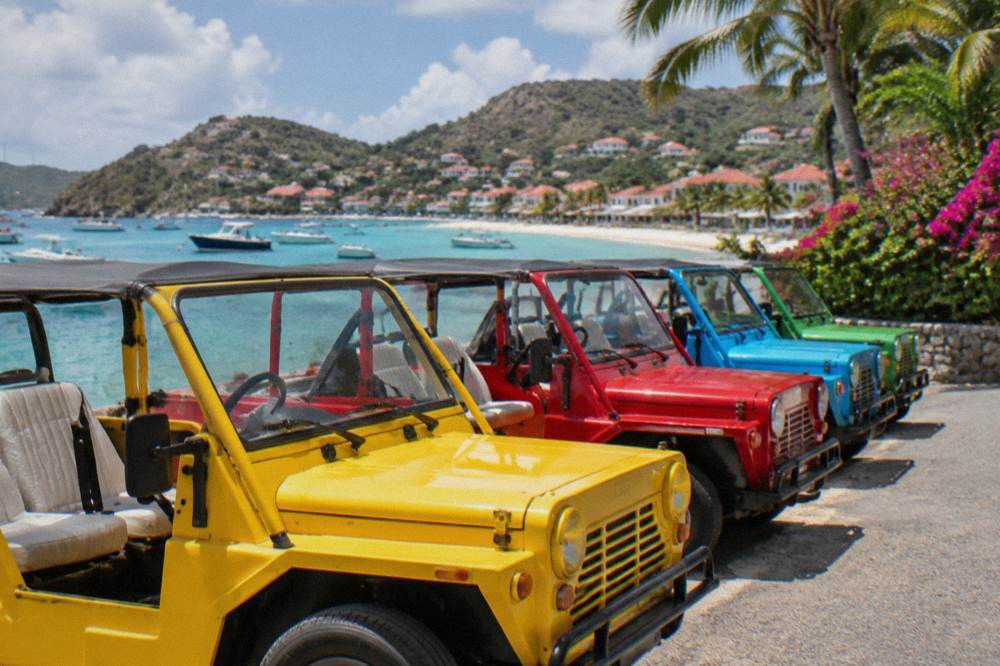
A Mini Moke is a small, open-sided car originally derived from the classic Mini, with no fixed roof, minimal bodywork and space for roughly four people, and in St Barts it has become the emblematic rental vehicle, offered by local agencies as a fun, air-conditioning-free way to move between beaches. It is a real car with a real engine and licence plate, not a golf cart, and it drives on public roads like any other vehicle.
The Moke began as a lightweight utility vehicle built on Mini mechanicals, and its modern descendants keep the same idea: a low, open body, a fabric roof or none at all, and simple controls. On an island where the speed limit is reported as 50 km/h island-wide and 30 km/h in Gustavia and Saint-Jean, a Moke's modest pace is not the limitation it would be on a mainland highway. What it trades away is weather protection and lockable enclosed storage, which matters more in the October-to-November wetter months than in the February-to-April drier stretch of the Meteo-France normals, 1991-2020.
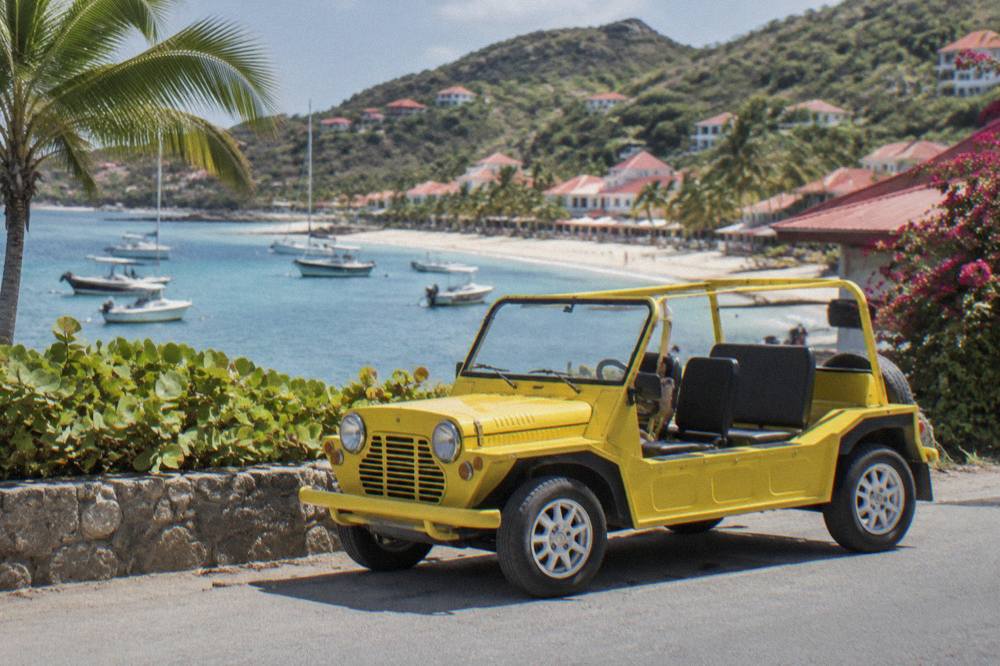
A Moke also shapes how a day feels. Doors are minimal or absent, the sea is audible from the seat, and parking a short, narrow vehicle in a tight roadside space is easier than manoeuvring a full-size SUV. Against that, anything carried is exposed, so soft bags that fit behind the seats work better than hard suitcases.
Why Rent A Mini Moke In St Barts?
A Mini Moke suits St Barts because the island's roads are narrow, steep and slow, distances between beaches are short, the climate is warm year-round with mean daily highs of 28.5 C in January to 31.7 C in September, and the open layout makes the drive itself part of the day rather than a chore between destinations. The trade-offs are exposure to sun and passing showers and limited secure storage.
The road network is the real argument. Local guidance describes the island's roads as narrow, winding and steep, with tight passing places and, in some stretches, limited markings. A small, open car with good visibility and a tight turning circle matches that geometry better than a wide SUV. The same guidance notes that automatic transmissions dominate the island's rental fleet, and Mokes are no exception.
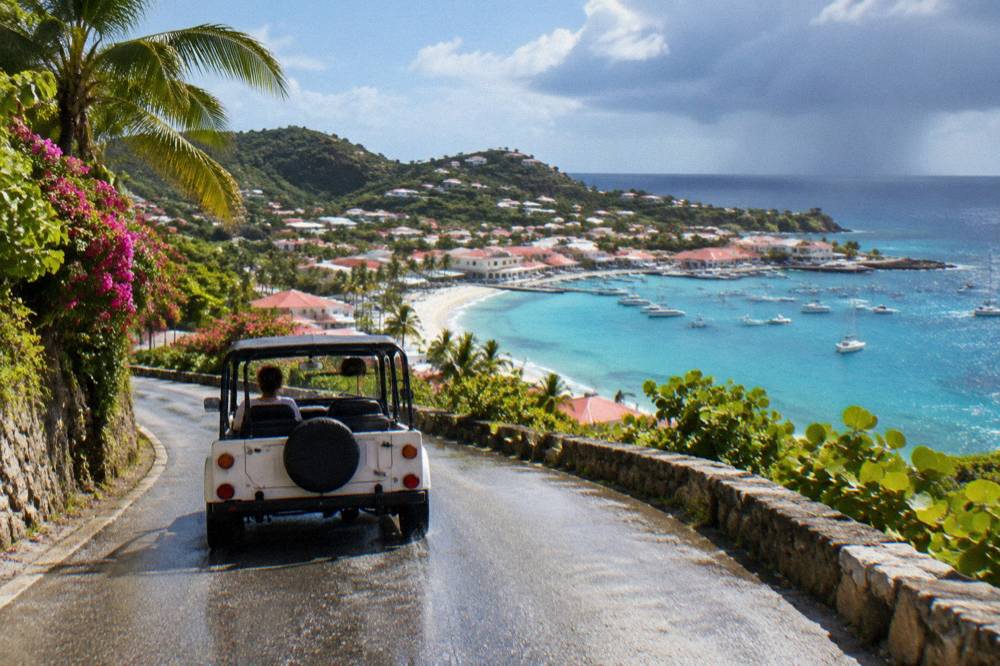
The climate argument is simpler. The Meteo-France normals, 1991-2020, put the mean daily high at 30.2 C across the year, and the sea stays warm, about 26 C in winter to about 29 C from August to October. An open car in that weather is pleasant for most of the year, with the caveat that October, the wettest month at 135.6 mm of rain in the normals, and November, at 118.6 mm, can deliver passing downpours that a Moke does nothing to keep off.
There is also the practical matter of what a Moke cannot do. It is not the vehicle for hauling luggage from the airport to a villa, and it offers little protection in the rare cool or wet spell. Plenty of travellers split the difference: a conventional car for arrival and departure days, a Moke for the beach days in between. For the broader question of whether a car is needed at all, see is it worth renting a car in St Barts.
Where Can You Rent A Mini Moke In St Barts?
Mini Mokes in St Barts come from local rental agencies rather than the international brands: the counters confirmed at Gustaf III Airport are Avis, Budget and Hertz, while Mokes are supplied by local operators such as Barthloc and other island agencies, several of which deliver a vehicle to a hotel or villa and collect it at the end of the rental. Booking ahead for the December-to-April high season is the standard advice in local guidance.
The split is worth understanding before booking. The international brands at SBH rent conventional cars. The Moke fleet sits with local specialists, which typically means booking by email or a simple web form, agreeing a delivery point, and handling paperwork in person on arrival. Local guidance notes that delivery to hotels and villas is commonly available from these agencies, which removes the need to drive to an office.
| Rental channel | Where it operates | What it supplies | Notes from local guidance |
|---|---|---|---|
| Avis | Counter at Gustaf III Airport | Conventional cars | International brand |
| Budget | Counter at Gustaf III Airport | Conventional cars | International brand |
| Hertz | Counter at Gustaf III Airport | Conventional cars | International brand |
| Local agencies (for example Barthloc) | Island-wide, with delivery | Mini Mokes and small cars | Delivery to hotels and villas commonly available |
Rental rates vary by season and by company, and the agency's own page shows current figures. The same applies to insurance terms, deposits and fuel policies, all of which differ between local operators and are worth reading before signing.
Booking timing matters more than price shopping. Local guidance recommends reserving well in advance for the December-to-April period, when the island's accommodation and vehicle fleet are both at their busiest, and confirming exact terms directly with the chosen company. Inspecting the vehicle thoroughly at pickup is standard advice for Mokes in particular, because their open construction means cosmetic wear accumulates, and documenting existing damage avoids disputes later.
What Is Driving A Mini Moke In St Barts Like?
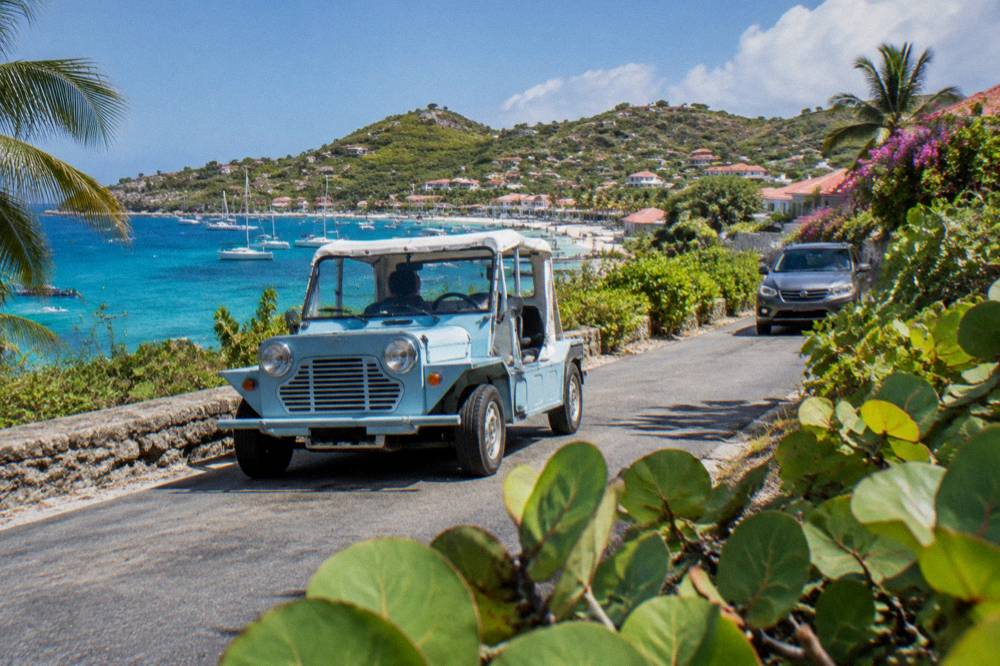
Driving a Mini Moke in St Barts means short, steep climbs, descents that call for low gear, blind crests and narrow passing places, all at low speed: traffic drives on the right, French right-of-way rules apply, including priority from the right at unsigned junctions, and the island has one roundabout near the airport and almost no traffic lights. It is manageable for a confident driver and tiring for a nervous one.
The terrain is the defining feature. Roads cross the island's central hills, and grades steep enough to require low gear are described in local rental guidance. A Moke's small engine handles these climbs at its own pace, and holding a steady line on a descent matters more than speed. Passing places are tight: when two vehicles meet on a narrow stretch, the more practical one reverses to a widened section, and Moke drivers often find themselves doing the reversing simply because their vehicle is the easier one to move.
| Driving condition in St Barts | What local guidance says | How a Moke handles it |
|---|---|---|
| Narrow roads with tight passing | Roads are narrow and winding | Short wheelbase makes giving way easy |
| Steep hills | Grades can require low gear | Small engine, steady low-speed climbing |
| Speed limits | Reported 50 km/h island-wide, 30 km/h in Gustavia and Saint-Jean | Low top speed is not a handicap |
| Right of way | French rules, priority from the right at unsigned junctions | Slower approach gives more reaction time |
| Roundabouts | One roundabout, near the airport | Standard French counterclockwise flow |
Weather adds a second layer. A Moke in sunshine is the picture postcard version of the island; the same Moke in one of October's heavier showers is a wet seat and a careful descent. The Meteo-France normals, 1991-2020, show why the calendar matters: October averages 135.6 mm of rain against February's 38.4 mm. A Moke rental still permits a spontaneous beach day, but in the wetter months a waterproof bag for phones and documents is sensible kit.
What Are The Rules For Renting And Driving In St Barts?
Driving in St Barts follows French rules: drive on the right, carry a valid licence from your home country, and expect an International Driving Permit to be needed only for licences in non-Roman alphabets, while the minimum driver age varies by rental company and no island-wide figure applies, and French overseas entry rules govern the documents you arrive with, not Schengen rules, since St Barts is outside the Schengen area.
The licence picture is practical rather than dramatic. Local rental guidance says a valid home-country licence, held for at least a year by some companies, a passport or ID and a credit card in the driver's name are the standard requirements, with additional drivers meeting the same criteria. Because the minimum age and any young-driver surcharge are set per company, the answer is the rental agreement itself, not a published island rule.
| Requirement | What applies in St Barts |
|---|---|
| Side of the road | Right |
| Licence | Valid home-country licence; IDP typically only for non-Roman alphabets |
| Minimum age | Varies by company; set by the rental agreement |
| Documents at pickup | Licence, passport or ID, credit card in the driver's name |
| Speed limits | Reported 50 km/h island-wide, 30 km/h in Gustavia and Saint-Jean |
| Right of way | French rules, including priority from the right at unsigned junctions |
Two island-specific rules deserve a line of their own. First, dogs are banned from all beaches island-wide under a municipal order, and the marine nature reserve's environment agency page adds its own restrictions in protected zones, so a Moke trip with a dog has limited destinations. Second, drones are prohibited in or near the reserve without authorization, which affects anyone planning aerial footage of a Moke route around Colombier or the northern coast.
For the paperwork that gets you to the island in the first place, St Barts being outside the Schengen area matters: entry runs under French overseas rules, and travellers should check their own government's travel advice for current passport requirements. The island's arrival logistics are covered in how to get to St Barts and in the St Barts airport guide, including why only small turboprops land at Gustaf III on its 646 m runway.
Mini Moke Or Rental Car: Which Fits A St Barts Trip?
A Mini Moke fits a St Barts trip built around beaches, sunshine and short daily distances, while a conventional rental car fits trips involving luggage, rain, more passengers or air conditioning, and many travellers book a car for arrival and departure days and a Moke for the beach days in between; the decision rests on weather tolerance and storage needs, since both drive the same roads under the same rules.
The honest comparison is narrow because the vehicles share a purpose. Both are rented for the same roads, both park in the same places, and both obey the same 50 km/h and 30 km/h limits. What separates them is the enclosure: a car keeps luggage, electronics and occupants dry and lockable; a Moke keeps none of those things but turns every drive into open-air sightseeing.
| Factor | Mini Moke | Conventional rental car |
|---|---|---|
| Weather protection | Open, minimal cover | Full enclosure and air conditioning |
| Luggage security | Exposed storage | Lockable boot |
| Narrow-road handling | Very compact, easy to give way | Wider, more reversing at passing places |
| Suitability with children | No enclosable child space by design | Standard child-seat fitting |
| Wet-season use | Passing showers reach the cabin | Unaffected |
| Where rented in St Barts | Local agencies | Airport counters and local agencies |
Families with young children often find the car the simpler answer, since child seats anchor conventionally and the cabin encloses. Couples on a dry-season trip often find the Moke answer makes itself. For a wider look at vehicle choice, renting a car in St Barts covers the conventional fleet, and the car-versus-Moke question sits inside the broader getting around St Barts picture, where Gustavia's compact centre means the town itself is easily walked on the days a vehicle stays parked.
What Routes Suit A Mini Moke Around St Barts?
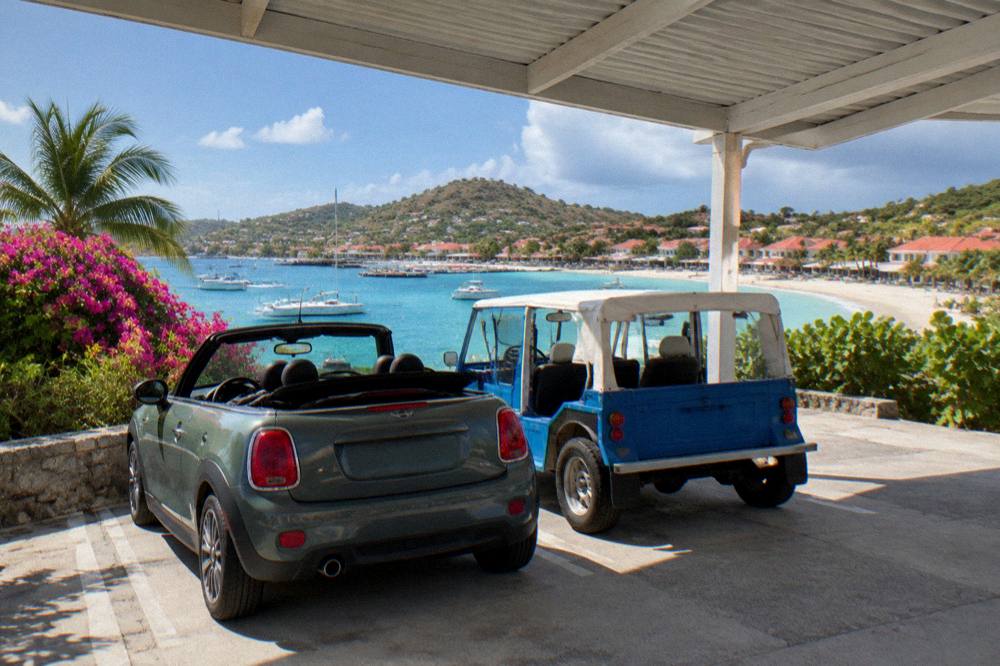
A Mini Moke route around St Barts naturally strings together the public beaches on the island's ring of roads, from Saint-Jean and Flamands near the airport to Gouverneur and Saline in the south, Shell Beach beside Gustavia, Colombier at the northwestern tip, and Grand Cul-de-Sac and Toiny on the quieter eastern side, with every beach on the island public and free to access and no route needing more than the island's own slow pace.
All beaches in St Barts are public, which makes a Moke day a beach-hopping day by default. The tourism committee's beach listings name the full set: Saint-Jean, Gouverneur, Saline, Shell Beach (Grand Galet), Flamands, Colombier, Grand Cul-de-Sac, Lorient, Toiny, Marigot, Corossol and Anse des Cayes. A sensible loop groups them by coast so the day is not spent crossing the central hills repeatedly.
| Moke-friendly beach group | Beaches on the route | Character of the segment |
|---|---|---|
| Airport and north shore | Saint-Jean, Anse des Cayes, Flamands | Close to the airport roundabout, built-up then open |
| Southern beaches | Gouverneur, Saline, Shell Beach (Grand Galet) | Hill climbs over the center, then the south coast |
| Gustavia area | Shell Beach (Grand Galet), Corossol | Compact harbour town, then the western village |
| East and northeast | Lorient, Grand Cul-de-Sac, Toiny, Marigot | Quieter roads, lagoon side of the island |
| Northwestern tip | Colombier | Reached at the end of the island's road network |
Colombier deserves its own note. The beach sits at the end of the road network on the northwestern tip, inside the area covered by the marine nature reserve, and the environment agency's regulatory-zones page governs activity there, including the 5-knot limit on the water and the ban on jet skis. Several beaches in this guide have their own pages, including Colombier Beach, Saline Beach, Gouverneur Beach and Shell Beach, each with its access details.
A Moke also earns its keep beyond beaches. Gustavia's shopping streets, the sunset spots on the western side, and the viewpoints over the hills between Flamands and Grand Cul-de-Sac all sit on exactly the kind of short, scenic drives the vehicle is built for.
When Is The Best Season For A Mini Moke In St Barts?
The best season for a Mini Moke in St Barts is the drier half of the year covered by the Meteo-France normals, 1991-2020, roughly December through April, when monthly rainfall runs from 38.4 mm in February to 79.2 mm in December against October's 135.6 mm, while hurricane season runs from 1 June to 30 November with its peak from mid-August to mid-October, overlapping the months an open car handles least well.
The numbers do most of the work. February is the lowest-rainfall month in the normals at 38.4 mm, March follows at 41.4 mm, and the December-to-April stretch holds every month under 80 mm. From August onward the monthly totals climb through September's 96.9 mm to October's 135.6 mm. Temperatures barely move: the mean daily high ranges from 28.5 C in January to 31.7 C in September, so warmth is never the variable, only rain.
| Month | Mean daily high (C) | Rain (mm), Meteo-France normals 1991-2020 | Moke outlook |
|---|---|---|---|
| January | 28.5 | 52.6 | Dry-season open-top driving |
| February | 28.6 | 38.4 | Lowest rainfall of the year |
| April | 29.8 | 50.9 | Late dry season, busy roads |
| July | 31.2 | 80.4 | Wetter, within hurricane season |
| September | 31.7 | 96.9 | Peak hurricane window |
| October | 31.4 | 135.6 | Wettest month in the normals |
| December | 28.9 | 79.2 | High season begins |
Two seasonal patterns complete the picture. Many hotels and restaurants close each autumn and reopen between mid-October and early November, so a Moke trip in late September intersects a quieter island with fewer open tables, while a December trip intersects the high season and the busiest roads of the year, when booking the vehicle well in advance matters most. No storm can be predicted for a date, and none is here: the hurricane season's existence is a planning fact, not a forecast.
How Does A Mini Moke Fit A St Barts Itinerary?
A Mini Moke fits a St Barts itinerary as the ashore-days vehicle: use it for beach hopping, Gustavia shopping trips and sunset drives, then hand the sea days to the boat tours, all of which depart from St Martin or Sint Maarten and visit St Barts by water, meaning a Moke-and-boat trip usually pairs an island stay with a sailing day booked from the neighbouring island rather than from Gustavia.
The division of labour is clean. The Moke covers the island's roads; the boats cover the water, and the water matters here, because the marine reserve's 23 dive sites, its turtle populations and the anchorages at Colombier and Ile Fourchue are reached from the sea. The one per-person group sail listed here runs only from 12 May to 31 August 2027 on its listing, which places it squarely in the low-season window where a Moke is also cheaper-looking on wetter days; five of the six boat products are private charters priced per group.
Planning the pairing is mostly sequencing. A typical split keeps the Moke for the arrival day's grocery run and the beach loop, reserves one full day for a boat trip to Colombier and Ile Fourchue, and leaves the final day for a slow Gustavia morning before the flight or ferry back. First-timers will find fuller sequencing in the St Barts first-timer itinerary and the St Barts itinerary, while a longer stay can borrow structure from one week in St Barts.
What Should You Know Before Booking A Mini Moke In St Barts?
Before booking a Mini Moke in St Barts, know five things: book through a local agency rather than expecting one at an international airport counter, reserve well ahead for December to April, read the insurance and deposit terms in the rental agreement because no island-wide rule sets them, plan for exposed luggage and passing showers, and drive on the right under French rules with reported limits of 50 km/h island-wide and 30 km/h in Gustavia and Saint-Jean.
Each of those five has a practical edge. Local agencies commonly deliver to hotels and villas, so a pickup point can be the accommodation itself. The high-season advice to reserve early applies to Mokes more than to conventional cars, because the Moke fleet is smaller. Insurance terms differ between operators, and the agreement is the only authoritative version. Exposed storage means packing soft bags and using a dry bag in the wetter months. And the driving rules, right-side traffic, French priority from the right, the single roundabout near the airport, are the same as for every other vehicle on the island.
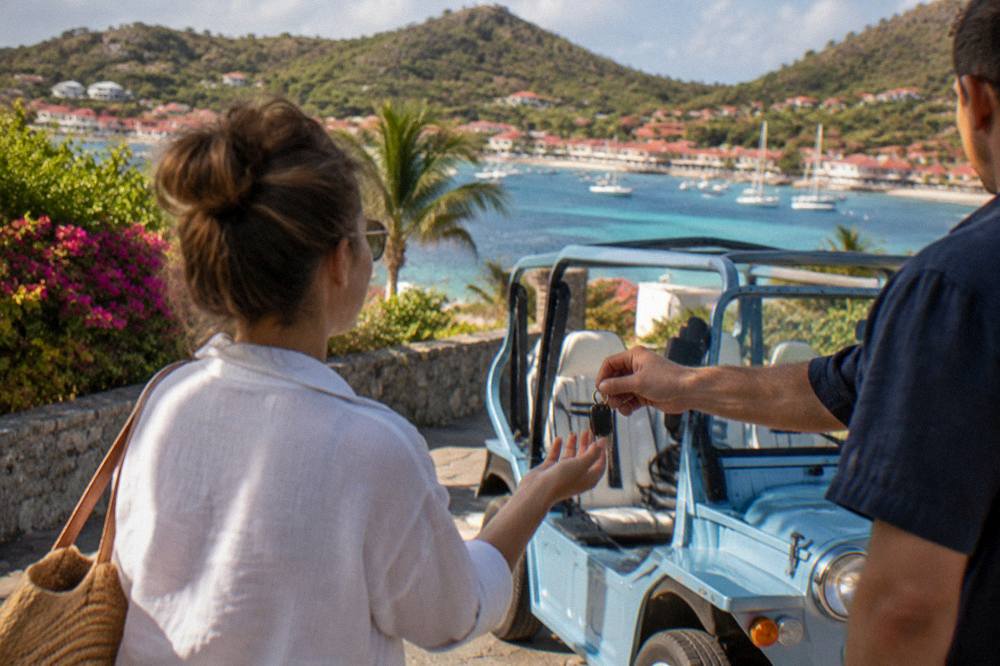
One last seasonal note: the Moke's best months and the island's biggest events overlap. The St Barth Music Festival runs 8 to 18 January 2027 and the Gourmet Festival 9 to 15 November 2026, and both fall inside or beside the dry-season window when an open car is at its best. A Moke, a dry month and a festival calendar make a workable trip outline, and the vehicle does the rest.
Common Questions About Renting A Mini Moke In St Barts
Can you rent a Mini Moke at St Barts airport?
The international counters confirmed at Gustaf III Airport are Avis, Budget and Hertz, which supply conventional cars. Mini Mokes come from local island agencies, several of which deliver a vehicle to a hotel or villa and collect it when the rental ends.
Do you need a special licence to drive a Mini Moke in St Barts?
No. A valid home-country driving licence is the standard requirement, with an International Driving Permit typically needed only for licences issued in non-Roman alphabets. Rental agencies also ask for a passport or ID and a credit card in the driver's name.
What is the minimum age to rent a Mini Moke in St Barts?
The minimum driver age varies by rental company, and some apply a surcharge for drivers under 25. There is no single island-wide age, so the rental agreement with the chosen agency sets the rule.
Is a Mini Moke safe on St Barts roads?
The island's roads are narrow, winding and steep, with reported speed limits of 50 km/h island-wide and 30 km/h in Gustavia and Saint-Jean. A Moke drives the same roads under the same rules as any car; confident drivers manage it easily, while the open layout means seatbelts, sun protection and a slow pace matter more than in an enclosed vehicle.
When is the worst time to rent a Mini Moke in St Barts?
October is the wettest month in the Meteo-France normals, 1991-2020, at 135.6 mm of rain, and hurricane season runs 1 June to 30 November with its peak from mid-August to mid-October. An open car is least comfortable in that window, though no rain or storm can be predicted for a specific date.
Can you reach all St Barts beaches with a Mini Moke?
Yes. Every beach on the island is public and free to access, and the road ring connects Saint-Jean, Flamands, Gouverneur, Saline, Shell Beach, Corossol, Lorient, Grand Cul-de-Sac, Toiny and the roadhead above Colombier.