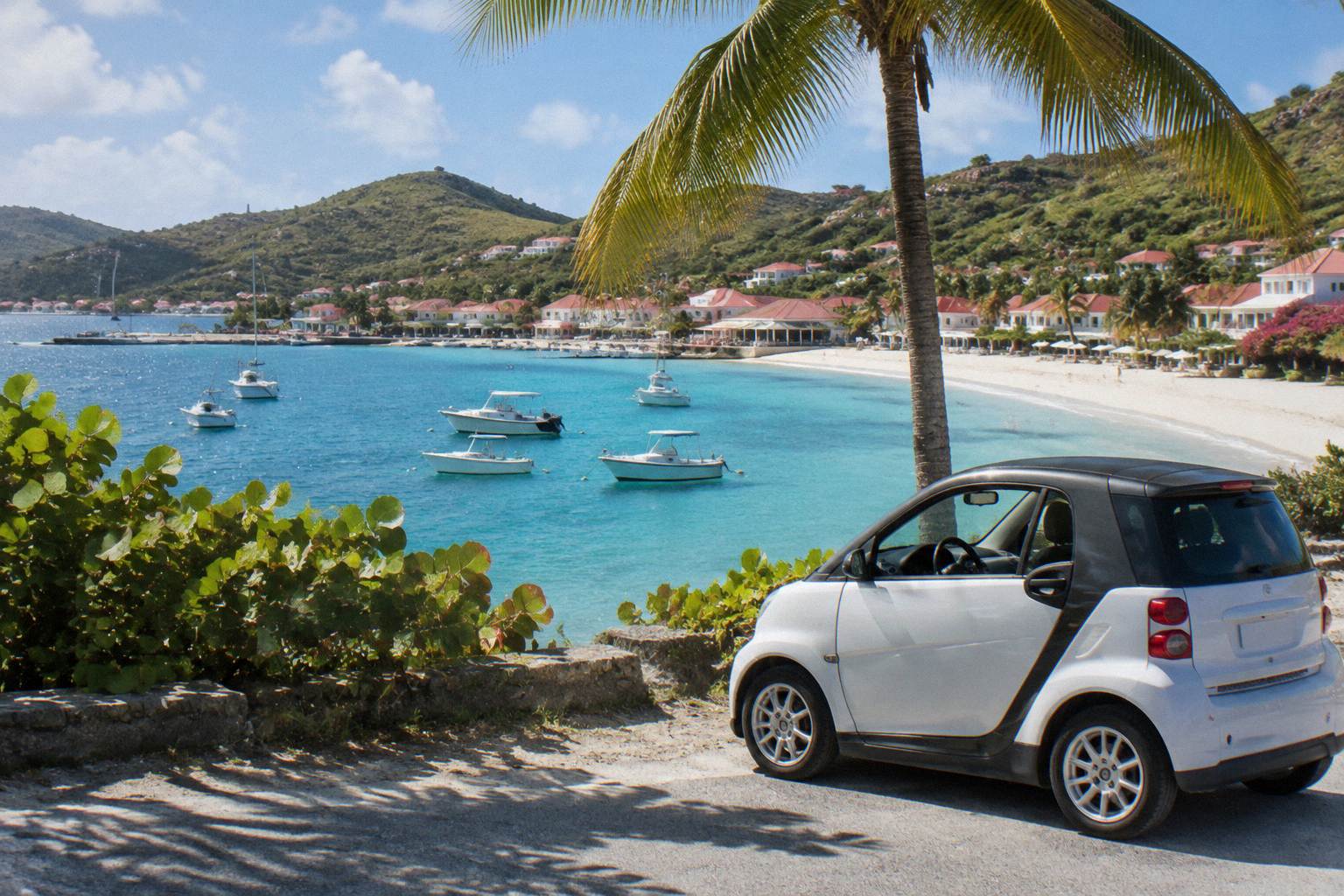
Is It Worth Renting A Car In St Barths?
A practical answer to whether renting a car on St Barts is worth it: how compact the island is, what driving is like, what the alternatives cost and when a rental makes sense.
St Barthelemy, written St Barts, is a French island in the Caribbean of about 21 square kilometres, roughly 10,700 residents and one compact harbour capital, Gustavia. That size is exactly why the rental question comes up so often: the island looks small enough to manage without a car, yet its beaches and villages sit at the ends of narrow, steep roads that climb over hills between coves. This page works through the question of driving there, what the alternatives are, and when a rental genuinely pays for itself. The fuller logistics, documents, vehicle types and pickup practicalities, are covered in the site's car rental guide for St Barts.
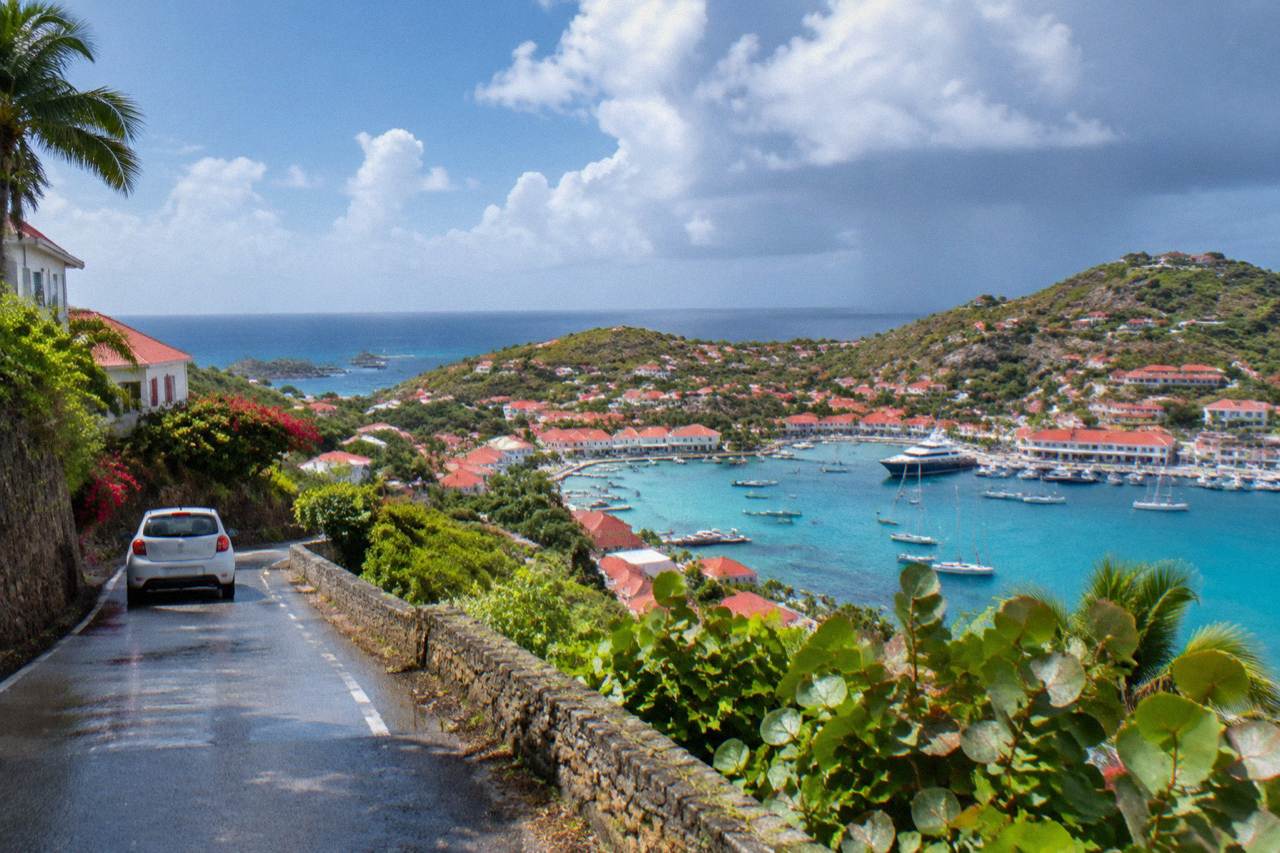
Yes, for the large majority of trips a rental car is worth it on St Barts, because the island's beaches, villages and lookouts are spread across steep hills connected by winding roads, and the alternative, relying on taxis for every journey, is both costly in euros and limiting in the evening. The main exceptions are short stays of two nights or fewer, boat-based itineraries and trips centred entirely on Gustavia, whose centre is compact and walkable.
The honest framing is spatial. About 21 square kilometres sounds trivial, but the roads between, say, Colombier's trailhead, Grand Cul-de-Sac and Corossol are not one flat ribbon: they rise and dip between coves, and the tourism committee's own area descriptions present the island as a set of distinct villages rather than a single strip. A car turns three beach stops into an easy day; without one, each becomes a negotiated taxi ride or a long walk in heat.
There is also a timing argument. Sunset spots, evening reservations and early morning airport runs all fall outside the hours when alternatives are frictionless. The island's sunset viewpoints in particular are scattered around the coasts, and a rental removes the return-leg problem that defines any taxi-based evening. The counterweight is that parking and road width demand confident driving, which the next sections address directly.
It helps to think of the decision in three layers. The first layer is geography: where the beaches actually sit. The second is rhythm: how often the plan moves. The third is confidence behind the wheel. A rental wins when the first two layers stack up and the third is not a barrier, and the rest of this page works through each layer with the figures and rules that apply.
What Is Driving In St Barts Actually Like?
Driving in St Barts is on the right, under French rules, on narrow, winding and steep roads with a reported island-wide limit of 50 km/h and 30 km/h in Gustavia and Saint-Jean. Rental counters at Gustaf III Airport include Avis, Budget and Hertz, alongside local agencies, and the vehicle of choice is small: compacts, small SUVs and the open-air Mini Moke, because tight roads and small parking spots punish anything larger.
Villa-manager and rental guidance repeatedly makes the same points. Low gears matter on the steep sections, some junctions are unsigned and follow the French priority-to-the-right rule, and there is a single roundabout near the airport. None of this makes driving difficult in absolute terms; it makes it demanding in attention, not skill. Drivers used to mountain roads will recognize the rhythm immediately.
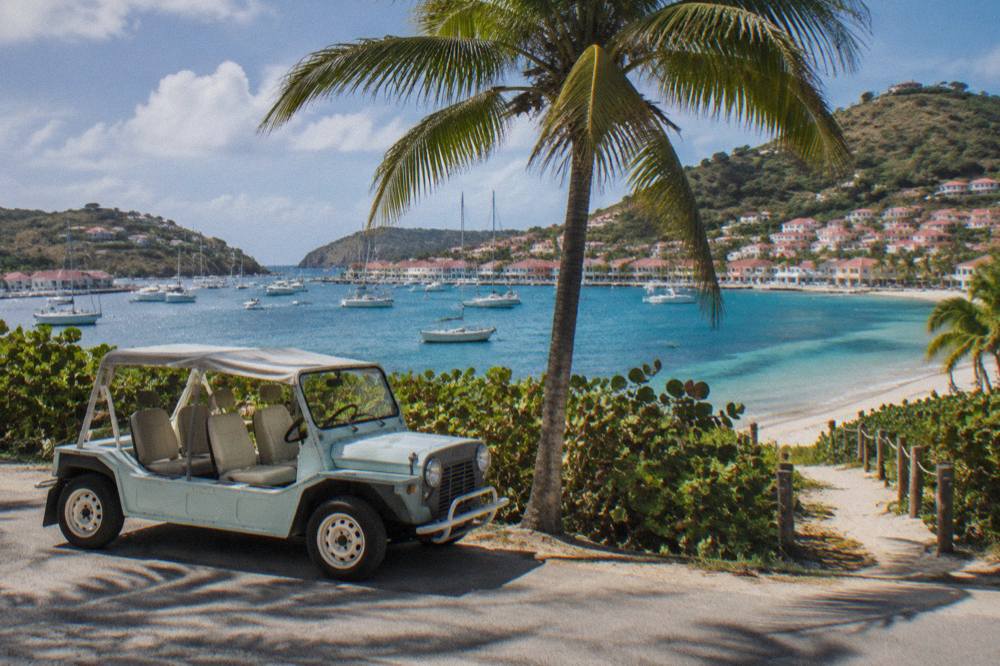
The vehicle choice follows the roads. Automatics dominate the rental fleet, and smaller, higher-clearance cars are the usual recommendation. The Mini Moke, the open-air island icon available through local agencies, trades protection for character and is covered in detail on the site's Mini Moke guide. What no source supports is the idea that a larger car is safer here: width is a liability on roads built for small vehicles.
A practical note on paperwork: a valid driving licence from the renter's home country is generally the requirement, with an International Driving Permit typically needed only for licences in a non-Roman alphabet, and a passport plus a credit card in the renter's name at pickup. Booking ahead is the standard advice for the December to April peak, and many local agencies deliver vehicles to hotels and villas, which can remove the airport-counter step entirely.
One more consideration is the marine environment that frames every drive. The environment agency's regulatory-zones page lists a 5-knot speed limit on the water in protected zones and bans jet skis, a reminder that the island's rules protect a fragile coastline. On land the equivalent is simple courtesy on narrow roads: local traffic, delivery vehicles and buses all share the same ribbons of asphalt, and pulling into a passing place to let an oncoming car through is routine island practice rather than an exception.
What Does A Rental Car Cost Versus Taxis On St Barts?
A rental is almost always the cheaper way to move around St Barts once a stay involves more than a couple of journeys a day, because taxi fares on the island are set per route and quickly multiply across a week of beach hopping, dinners and airport runs, while a rental is one flat cost with unlimited trips. Rates vary by season and company, and the operator or agency quotes the live number.
The comparison matters most in high season, December through April, when demand peaks. The practical arithmetic is structural rather than numeric: a taxi day with three round trips equals six paid legs, every day of the stay, whereas a rental decouples cost from movement. Anyone working through the island's itineraries, which move between coasts, gets more value from the flat cost than a visitor staying put in one village.
| Factor | Rental car | Taxis and transfers |
|---|---|---|
| Cost structure | One flat cost for the stay, unlimited trips | Paid per journey, per route, every leg |
| Flexibility | Any beach, any hour, spontaneous stops | Booked or hailed, evening legs add cost |
| Driving demand | Steep, narrow roads, small car advised | None, someone else drives |
| Parking | Needed at each stop, Gustavia centre is compact | Drop-off only, no parking concern |
| Best fit | Stays of 3 nights or more, multi-beach plans | Short stays, Gustavia-centric trips, arrival day |
One nuance the table hides: the two options are not mutually exclusive. Many travellers rent from the airport for the stay, then leave the car parked in the evening in Gustavia, whose centre is compact enough to walk. That hybrid captures most of the savings with none of the evening parking friction.
Season shifts the balance in a second way. In the quieter late spring and summer months, vehicle availability is easier and agencies have room to negotiate weekly terms, while in the winter peak both cars and taxis are in heavier demand and advance booking is the consistent recommendation across rental sources. Travellers planning around what St Barts costs should treat ground transport as a line item decided at booking time, not on arrival, precisely because the per-journey alternative is the one cost that compounds silently across a stay.
When Is A Car NOT Worth Renting On St Barts?
A car is not worth renting for stays of roughly two nights or fewer, for trips based entirely in Gustavia, and for itineraries built around the water rather than the land, because every bookable boat tour listed here departs from St Martin or Sint Maarten and visits St Barts by sea, making an island car irrelevant to the tour itself. Cruise passengers tendering into Gustavia for a day also rarely need one.
Start with the short stay. A two-night visit with one beach and dinners in town generates perhaps four or five journeys; the flat rental cost plus the effort of pickup and return does not clearly beat a handful of taxi legs. The same logic applies to a Gustavia-based trip: the harbour capital's centre is compact, its shops and restaurants sit close together, and the airport is a short hop away. Cruise visitors face the same arithmetic compressed into a single day: ships tender to Gustavia, there is no cruise pier, and a day spent between the harbour, Shell Beach (Grand Galet) and one farther beach is manageable without committing to a rental contract.
The boat case is the strongest. A day on the water replaces the day's driving entirely. The group sail that visits Gustavia, Colombier Beach and Ile Fourchue runs from St Martin, and its per-person window runs only from 12 May to 31 August 2027 on its listing, so a summer traveller can spend the whole day at sea and never touch a steering wheel on either island. Details and live pricing are on the operator's live listing through the operator's listing and the site's Gustavia, Colombier and Ile Fourchue tour page.
Colombier itself illustrates the limit of any car. The beach is public and reached on foot by trail, so the drive ends at the trailhead and the rest is legs; the trail details are in the site's Colombier hike guide. A rental gets you to the start of the island, not always to its farthest corners, and the best plans pair wheels with a willingness to walk.
How Do You Decide For Your Own Trip?
Decide by counting journeys, not by measuring the island: list every planned beach, village, dinner and viewpoint, add the airport legs, and if the total runs past about four or five trips across the stay, a rental wins on cost and freedom, while a short, Gustavia-centred or boat-based plan does better without one. Season matters too, since demand for both cars and taxis peaks from December to April.
A useful exercise is to sketch the week against the island's areas. A plan touching Flamands, Saline, Grand Cul-de-Sac and Corossol, the kind of spread the site's neighborhood guide makes visible, is a car plan. A plan built on one beach, one village and one boat day is not. The map, not the square kilometres, is what settles it.
| Trip profile | Car or no car | Why |
|---|---|---|
| Week, multi-beach, several areas | Car | Many journeys, flat cost wins across the stay |
| Long weekend, two bases | Car | Airport legs plus evening trips add up fast |
| Two nights in Gustavia only | No car | Compact centre, few journeys, short stay |
| Boat day tours from St Martin | No car needed | Tours depart from St Martin by sea |
| Cruise day in port | No car | Tender arrival, walkable harbour capital |
| Hiking-focused stay | Car for trailheads | Trails start at road ends across the island |
Two follow-up questions are worth settling early. The first is whether anyone in the party wants to drive at all, since the roads reward confidence. The second is arrival logistics: the counters sit at the airport, so the pickup decision happens at booking time, not on the island, and the deeper practicalities, documents and vehicle types are laid out in the car rental guide.
For families the calculus tilts toward a car: beach gear, shade and the flexibility to leave a crowded spot on demand matter more with children, and the site's family itinerary assumes wheels. For a honeymoon or a couple's escape the tilt can go the other way, with one evening taxi and days spent on foot or at sea. Neither profile changes the underlying rule; they only change how many journeys the plan stacks up.
Common Questions About Renting A Car In St Barts
Do you need a car in St Barts?
Not strictly, but a car is the practical choice for stays of three nights or more. The site's dedicated page on the question, do you need a car in St Barts, covers the no-car case, which works for Gustavia-based and boat-based trips.
Which side of the road does St Barts drive on?
The right. St Barts follows French traffic rules as an overseas collectivity of France, with a reported island-wide speed limit of 50 km/h and 30 km/h in Gustavia and Saint-Jean.
Is driving in St Barts difficult?
The roads are narrow, winding and steep, so driving demands attention rather than skill. Small vehicles, automatics and low gears on climbs are the standard advice, and local rental fleets favour compacts, small SUVs and Mini Mokes.
Can you rent a car at the St Barts airport?
Yes. Rental counters at Gustaf III Airport include Avis, Budget and Hertz, and local agencies on the island offer additional fleets, including the open-air Mini Moke. Rates vary by season and by company.
Is parking difficult on St Barts?
Parking availability is not addressed on this page. Gustavia's centre is compact and walkable, which lets many travellers park once and explore the harbour town on foot.
The short version: count the journeys, check the season, and let the map decide. For more on planning around the island, see St Barthelemy Travel and the one week itinerary.