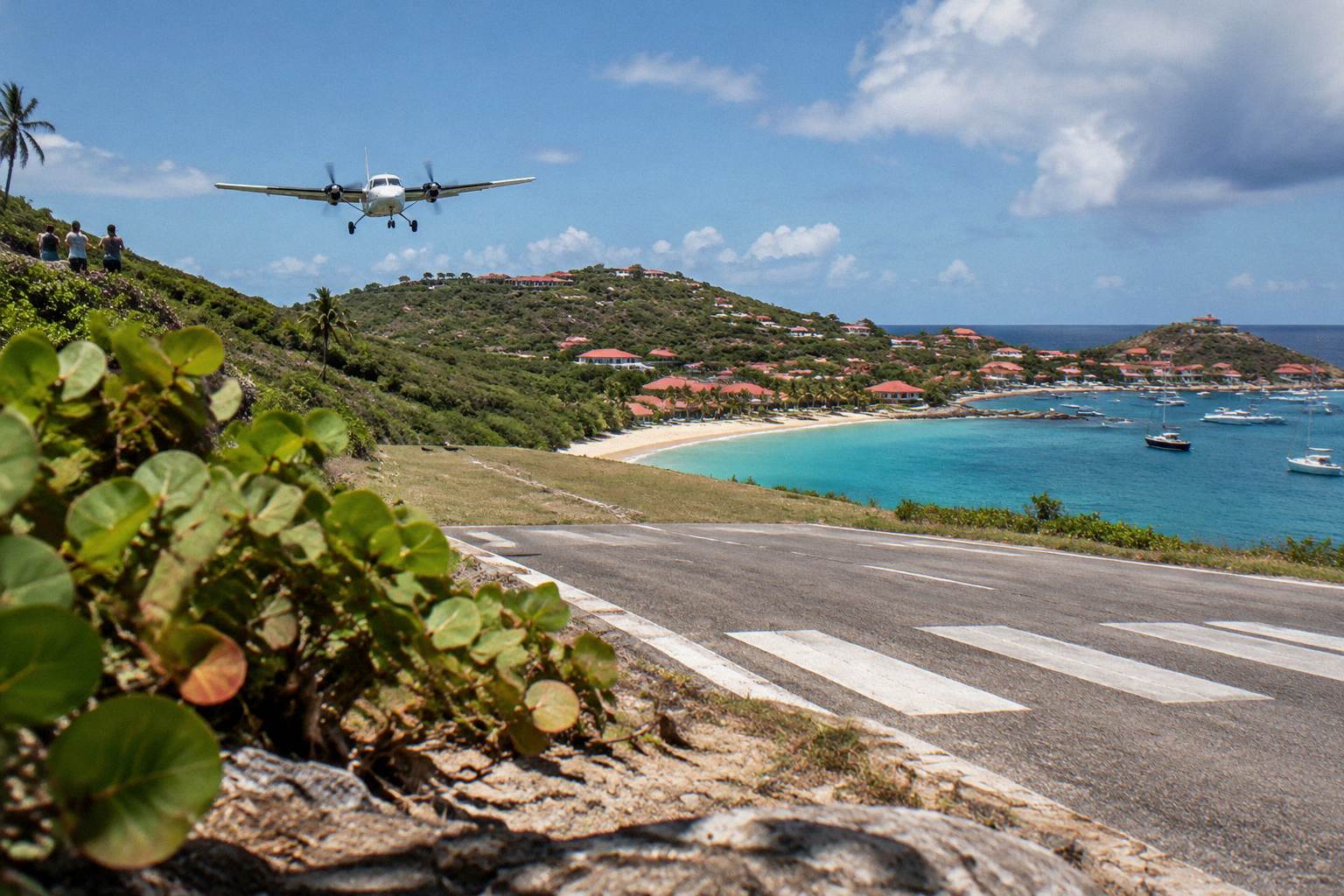
Watching Planes Land At St Jean
St Barthelemy's Gustaf III Airport has one of the most photographed approaches in the Caribbean, and the public road at Saint-Jean runs right under it. Here is where to stand, what lands, and how to fold an afternoon of arrivals into a St Barts day.
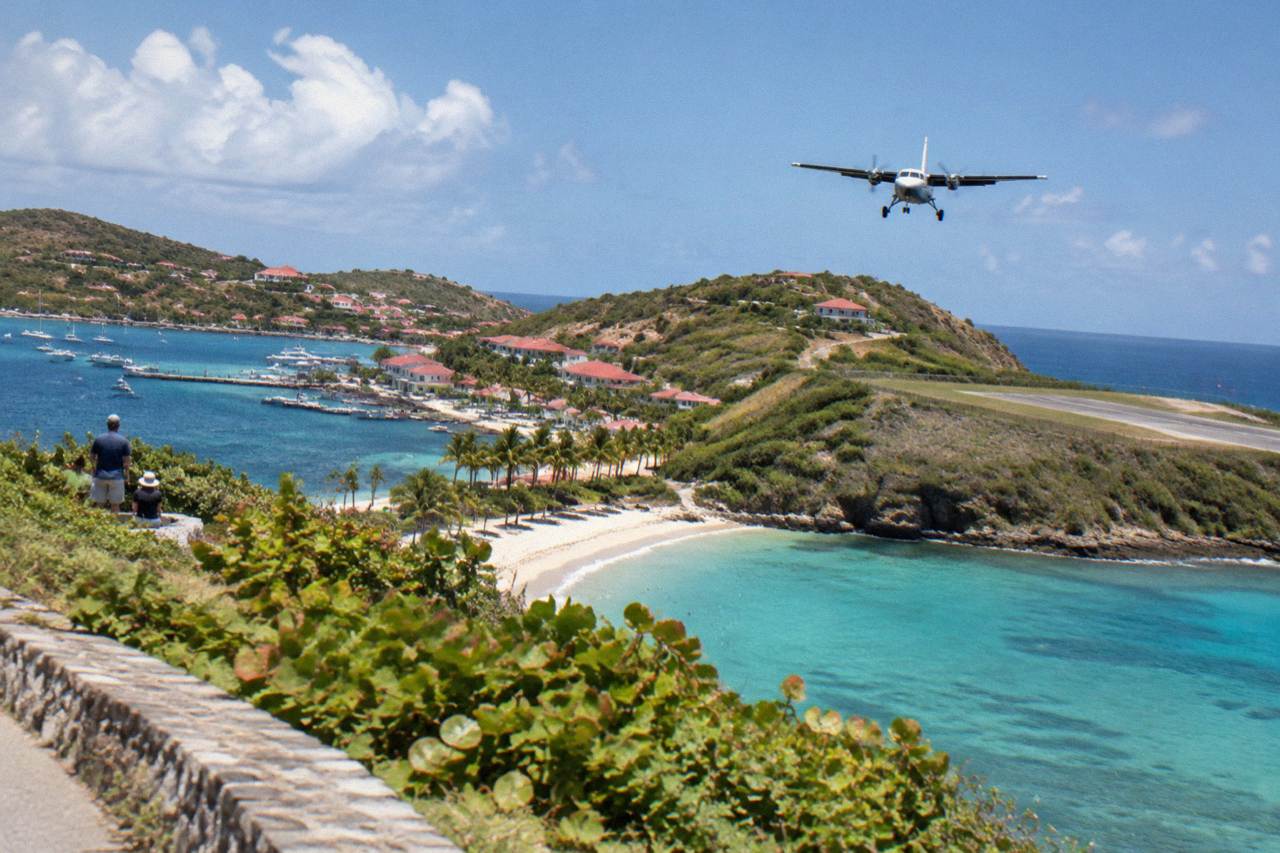
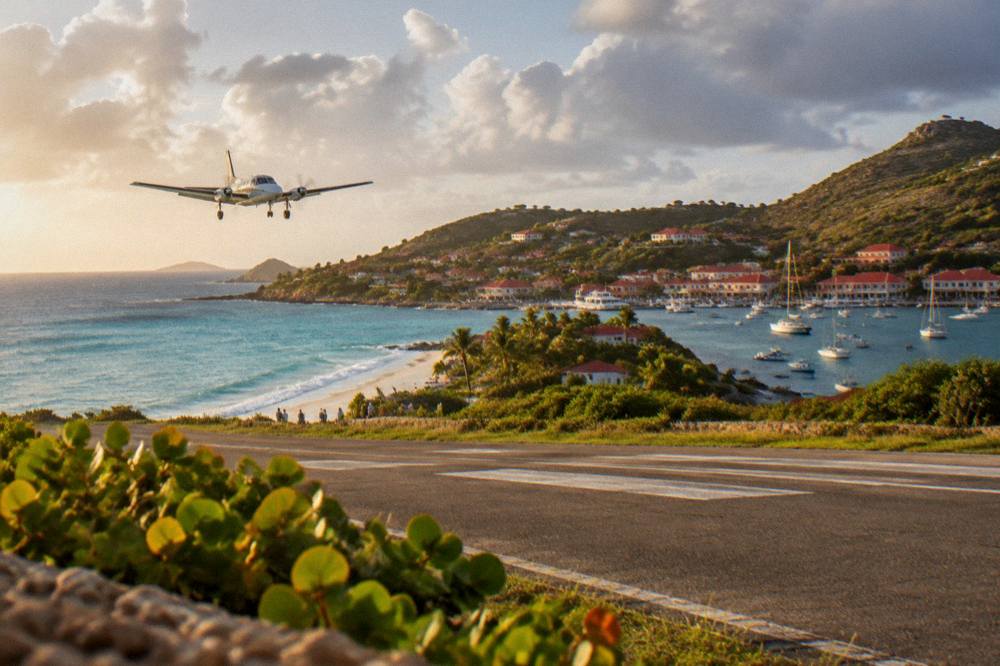
The place to watch planes land at St Barts is the public road and beach end at Saint-Jean, where the 646 m runway of Gustaf III Airport begins directly over the traffic. Only small STOL turboprops land here, in daylight and visual conditions only, so arrivals cluster in the middle of the day.
St Barthelemy, usually written St Barts, is the small French island in the Caribbean whose airport has become an attraction in its own right. Gustaf III Airport, also called Remy de Haenen and coded SBH, sits on a spit at the eastern end of Saint-Jean beach, and its single 646 m (2,119 ft) runway starts directly over a public road. People come to Saint-Jean specifically to stand at that road and watch small turboprops sink over the Col de la Tourmente hill, clear the traffic and touch down with very little runway to spare. The tourism committee lists the airport among the island's known sights, and for once the free thing really is the point: the road, the beach and the viewing spots cost nothing, and no guided walking tour of them exists on the island.
This page covers what actually lands at SBH, where the vantage points are around Saint-Jean, when the arrivals happen and why, and how to combine a spotting session with the rest of a day on things to do in St Barts. Nothing here involves booking an island activity, because no on-island tour is listed here; the bookable trips that touch St Barts all depart from St Martin or Sint Maarten and are covered further down.
What Kind Of Planes Land At St Barts?
Only small STOL turboprops land at St Barts: the 646 m (2,119 ft) runway at Gustaf III Airport rules out jets entirely, and operations are daylight, visual-conditions only. St Barth Commuter flies to SBH from St Martin (SXM), Grand Case (SFG) and Pointe-a-Pitre, Guadeloupe (PTP), while Tradewind flies in from San Juan (SJU) and Antigua (ANU). Winair flies the SXM to SBH hop on Twin Otters.
That constraint is the whole reason the spotting is good. The aircraft types serving the field are short takeoff and landing machines, the DHC-6 Twin Otter, the Cessna 208B Grand Caravan and the Pilatus PC-12 among them, and each arrival is a demonstration of steep approach flying over terrain. Pilots need a special qualification for the approach over the Col de la Tourmente, the hill between Gustavia and Saint-Jean that sits on the approach path. Because the airport opens in daylight and closes shortly after sunset, with no runway lighting, there is no night spotting and no late-evening arrivals: the show is a daytime one.
The hop from St Martin is a short one, which shapes the rhythm of the day. Travellers connecting off a long-haul jet at SXM step down onto a small turboprop for the final leg, so the arrival stream at SBH tracks the arrival stream at the regional gateways. No direct flight from outside the Caribbean lands on St Barts; anyone coming on a jet connects through St Martin, San Juan, Pointe-a-Pitre or Antigua first. The island's whole air link, in other words, funnels through a handful of small aircraft making repeated short hops, and Saint-Jean is where all of it becomes visible.
A quick summary of what the airport is, drawn from the published runway and operator details:
| Item | Detail |
|---|---|
| Airport name | Gustaf III / Remy de Haenen (SBH, TFFJ) |
| Runway | Single runway 10/28, 646 m (2,119 ft) |
| Aircraft permitted | Small STOL turboprops only, no jets |
| Operating hours | Daylight, visual conditions only, no runway lights |
| Approach feature | Steep descent over Col de la Tourmente hill |
| Scheduled operators | St Barth Commuter, Tradewind, Winair |
| Connect gateways | SXM, SFG, PTP, SJU, ANU |
Where Do You Watch The Planes Land At St Jean?
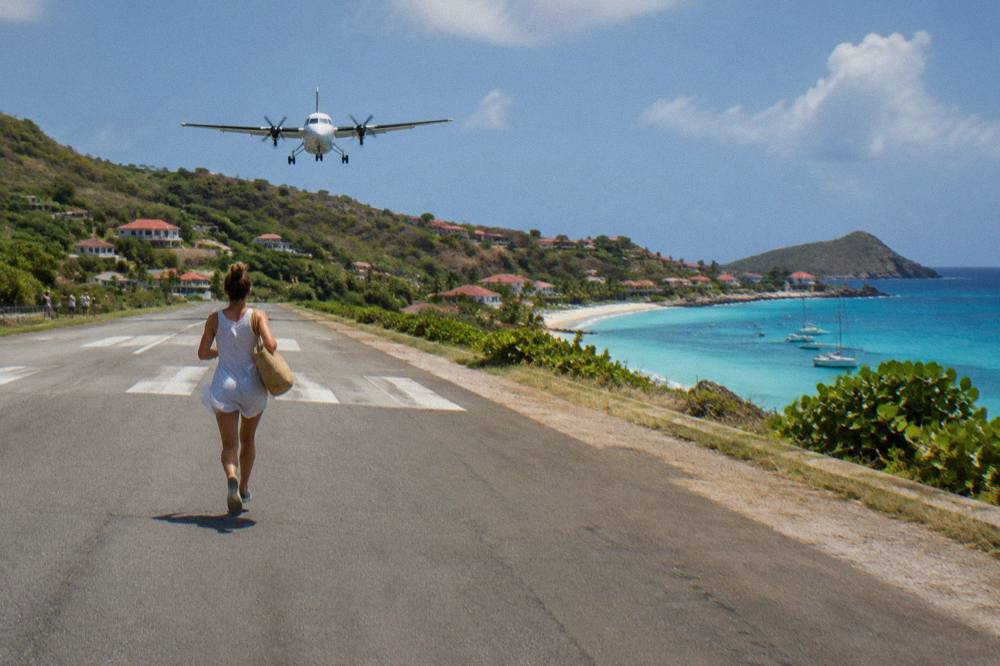
The main place to watch planes land at St Barts is the public road at the western end of the runway in Saint-Jean, where arrivals pass low directly over the traffic before touching down; the beach itself and the rising ground toward Col de la Tourmente give further vantage points on the approach path. All of these are public space, and Saint-Jean beach is public like every beach on the island.
The road crossing is the famous one. The runway begins on the far side of the road at the top of Saint-Jean, so an aircraft on short final passes over the road, over the fence line and onto the threshold in a matter of seconds. Standing back from the crossing, on the public shoulder, gives the clearest view of the descent, and standing to the side shows how little altitude the aircraft carries at that point. The Saint-Jean beach end nearest the airport is close enough that arrivals are a constant presence on any beach day there; the beach is public, and watching from it is free.
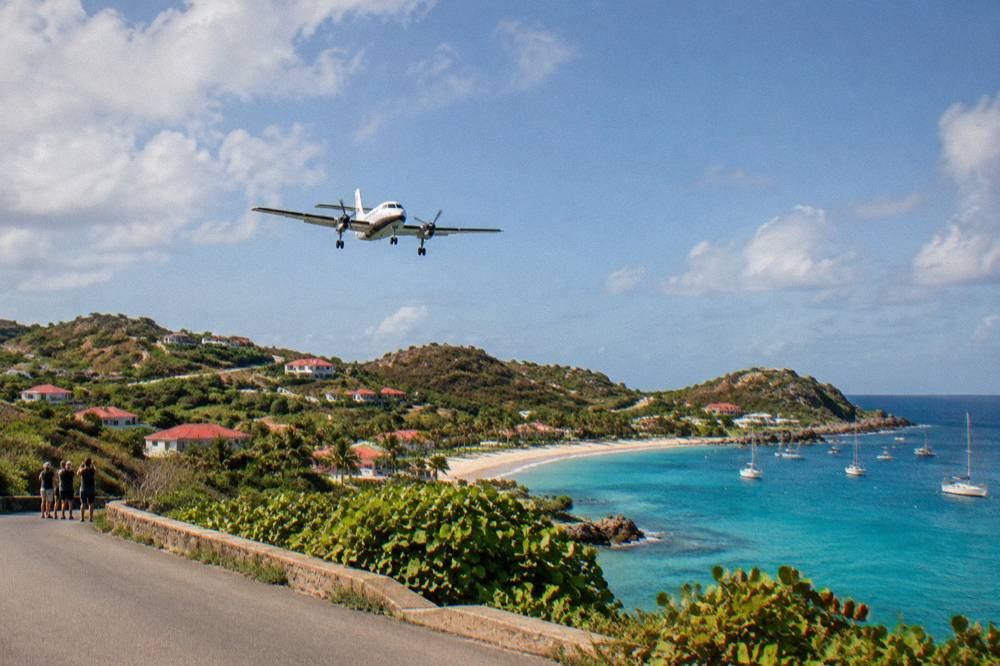
The second vantage is the hill itself. The road from Gustavia toward Saint-Jean climbs over the Col de la Tourmente, and from the higher ground the approach path is visible end to end: the aircraft dropping toward the island, the runway below and the lagoon beyond. This is the view most photographs of the airport try to capture. The area guide to the Saint-Jean area covers the rest of the neighbourhood, the shops on one side and the water on the other, and it is all walkable in the same loop as a spotting stop.
Two cautions from the published rules of the place. First, the road is a live road: the island speed limit is 50 km/h island-wide and 30 km/h in built-up areas including Saint-Jean, and the crossing has actual traffic on it, so the shoulder and the designated standing room, not the roadway, are where to be. Second, the marine nature reserve bans drones in and near its zones without authorization, and the airport approach is the last place an unauthorized drone belongs; the environment agency's regulatory-zones page lists those rules. There is no official viewing terrace and no organized spotting tour; the vantage points are simply public road and public sand.
The vantage points in summary:
| Vantage point | What you see | Access |
|---|---|---|
| Road crossing at runway end | Aircraft passing directly overhead on short final | Public road shoulder at Saint-Jean |
| Saint-Jean beach, airport end | Arrivals over the fence line from the sand | Public beach |
| Col de la Tourmente road | The full approach path and runway from above | Public road toward Gustavia |
| Lagoon side at Grand Cul-de-Sac | Departures climbing out toward the east | Public beach area |
For travellers weighing whether the airport's reputation for difficulty is deserved, the separate answer page on whether St Barts is one of the worst airports to land at covers the pilot-qualification side of the same question.
When Do The Most Arrivals Happen At St Barts?
Arrivals at St Barts happen only in daylight, in visual conditions, so the middle of the day carries the traffic; the airport opens around first light and closes shortly after sunset, with no runway lighting for night operations. Weather can stop flights entirely, since the approach requires visual conditions over the hill, and frequencies rise in the November to April high season.
The daylight rule is structural, not a preference. With a 646 m runway and no lights, SBH operates only while pilots can see the field, and the steep approach over Col de la Tourmente demands visual reference throughout. On a clear day the arrival stream is steady from mid-morning onward; on a cloudy or hazy day the same approach can be impossible, and flights hold, divert or cancel. This is why the island keeps a ferry alternative from St Martin: Great Bay Express from Philipsburg and Voyager from Marigot both run to Gustavia, giving a sea option when the air option closes.
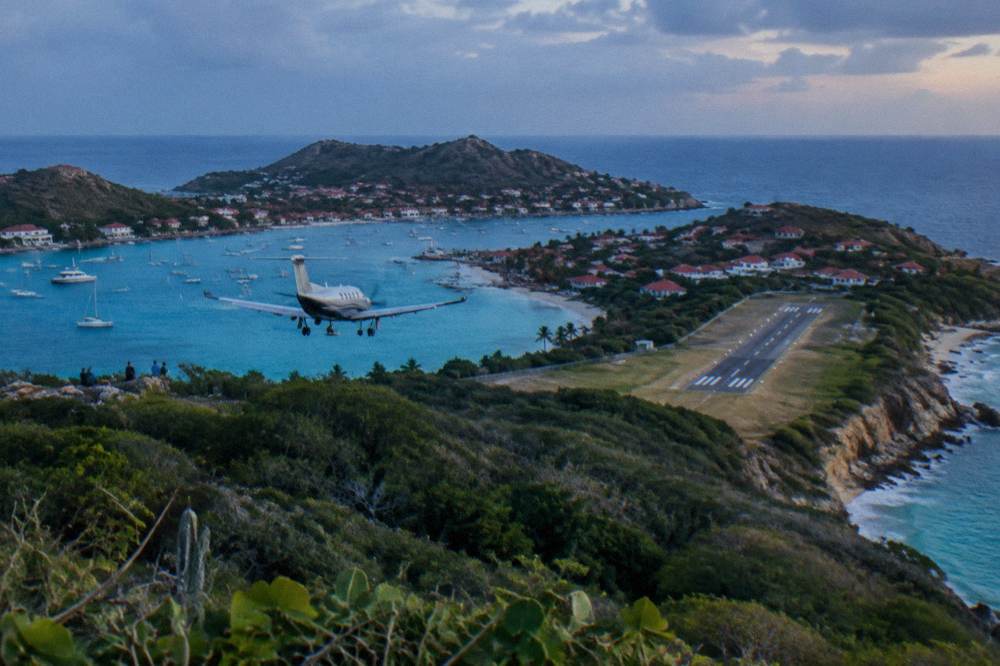
Season matters in two ways. The November to April period is the island's high season, and the carriers add capacity then, so a winter afternoon at Saint-Jean sees more movements than a summer one. The autumn is the quieter period for a different reason: many hotels and restaurants close each autumn and reopen between mid-October and early November, and the traffic follows the season. Weather in the September to November window is also the wettest of the year; the Meteo-France normals for St Barthelemy, 1991-2020, put October at 135.6 mm of rain, the wettest month, against February's 38.4 mm, and mean daily highs run from 28.5 C in January to 31.7 C in September. A spotting plan in the shoulder months should carry a weather alternative, and the hurricane season runs 1 June to 30 November with its peak mid-August to mid-October, though no storm can be predicted for any date.
| Period | Arrivals at SBH | Notes |
|---|---|---|
| November to April | At their heaviest | High season, added capacity on gateway routes |
| May to August | Steady | Warm and settled, mean highs near 31 C |
| September to October | Lightest | Wet autumn, 96.9 mm in September and 135.6 mm in October; autumn closures |
| Any day | Daylight only | Visual conditions required; no night operations |
The practical reading: pick a mid-morning to mid-afternoon window, check that the sky over the hill is clear, and let the rest of the day flex around it. If a flight day matters to you, whether your own arrival or a friend's, the same daylight rule means the last arrivals of the day land well before sunset, not at dusk.
Can You Combine Plane Spotting With A Beach Day At Saint-Jean?
Yes: Saint-Jean is one beach and one airport strip in a single public space, so a spotting session costs nothing extra on a beach day there, and the whole loop from the road crossing to the sand takes in departures climbing out over the water as well as arrivals over the road. Every beach on St Barts is public, including Saint-Jean, so there is no entry, no club requirement and no fee to be near the flight path.
The geography does the work. The runway occupies the low spit at one end of the bay, the public beach runs along the water, and the road threads between them. A morning on the sand puts you within sight of every movement; a short walk to the crossing puts you under the ones on final. When the aircraft turn is quiet, the bay itself is the attraction, and the Saint-Jean area guide maps the shops and the village streets that fill the gaps between arrivals. The pattern repeats with variations elsewhere: Shell Beach by Gustavia, Saline on the south coast and Flamands on the north all pair a public beach with a short drive, though only Saint-Jean has the runway.
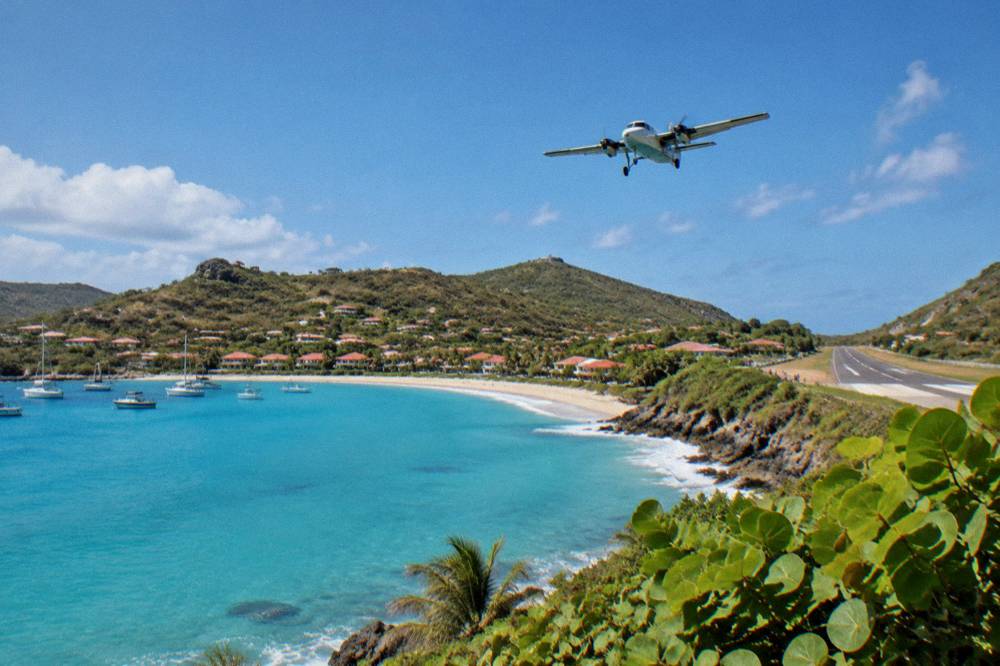
For anyone basing themselves in the neighbourhood, the guide to Hotel Le Village in Saint-Jean covers a property within walking distance of both the beach and the viewing spots; rates vary by season and the property's own booking page shows them. A rental car, booked through one of the agency counters at the airport such as Avis, Budget or Hertz, or a local agency with a Mini Moke, makes the whole circuit easy; driving is on the right, roads are narrow and steep, and the island speed limit is 50 km/h with 30 km/h zones in Gustavia and Saint-Jean.
A simple day plan built around the arrivals window:
| Time of day | Where | What happens |
|---|---|---|
| Morning | Saint-Jean beach | Early arrivals over the road end, quiet sand |
| Midday | Road crossing and shoulder | Steadiest stream of arrivals and departures |
| Afternoon | Col de la Tourmente road | Overhead views of the approach path |
| Late afternoon | Gustavia or a west-facing shore | Last movements, then sunset; the sunset spots guide lists the viewing points |
Is The St Barts Airport Approach Dangerous To Watch Or Fly?
Flying into St Barts is a specialist operation rather than a risky spectacle: the 646 m runway, the steep approach over Col de la Tourmente and the visual-conditions rule mean only qualified pilots on STOL-certified aircraft operate there, and watching from the public road at Saint-Jean carries no more risk than standing at any live road crossing, provided you stay off the roadway itself.
The safety framing around SBH comes from the same facts that make it interesting. The runway is short by any standard, the approach is steep over terrain, and the whole operation shuts down when the weather stops being visual. Those constraints are why the aircraft are small, why the crews are specially qualified and why no jet has ever been able to land there. For the spotter, the rules are ordinary ones: stand clear of the road, expect real traffic at the crossing, and keep drones packed away, since the environment agency prohibits them in and near the reserve zones without authorization and the approach path is controlled airspace. The 5-knot speed limit the agency sets on boats in its protected zones is a separate rule but reflects the same regulatory care around the island's natural spaces.
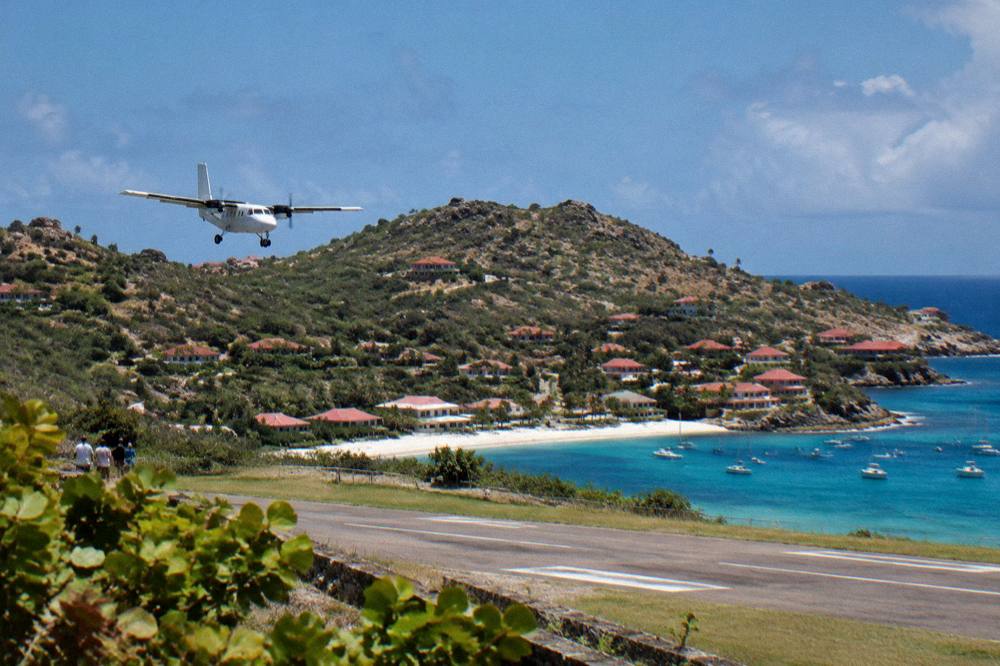
For travellers, the honest planning note is that the ferry exists precisely because the air bridge is weather-dependent. Great Bay Express runs from Philipsburg on the Dutch side and Voyager from Marigot on the French side, both to Gustavia, and both crossings can be rough; no smooth crossing is ever promised. If watching planes is the plan but flying into the island is not, the ferry plus a day around Saint-Jean delivers the same show from the ground.
How Do You See The St Barts Coast And The Airport In One Trip?
The airport show is a St Barts experience, but the bookable boat trips that visit St Barts all depart from St Martin or Sint Maarten, never from the island itself, so the pattern that works is a day trip by sea with a stretch of island time at Saint-Jean or a land-based stay paired with a charter day. The group sail to Colombier and Ile Fourchue and the private charters from St Martin between them cover the coast; the spotting is free and ashore.
The one per-person product listed here is the group sail and snorkel trip to Gustavia, Colombier and Ile Fourchue, which departs from St Martin or Sint Maarten and runs on its listing from 12 May to 31 August 2027; it is the budget-friendliest way onto the water, and its island stop can be planned against an afternoon of arrivals. See the live listing. Alongside it sit the private charters, priced per group, and the overnight catamaran for anyone who wants the crossing and the anchor bay to themselves; the comparison band below carries all three.
For a pure charter day, the full-day private option below is the flexible one, with the route and the time at each stop set by the group rather than a shared schedule.
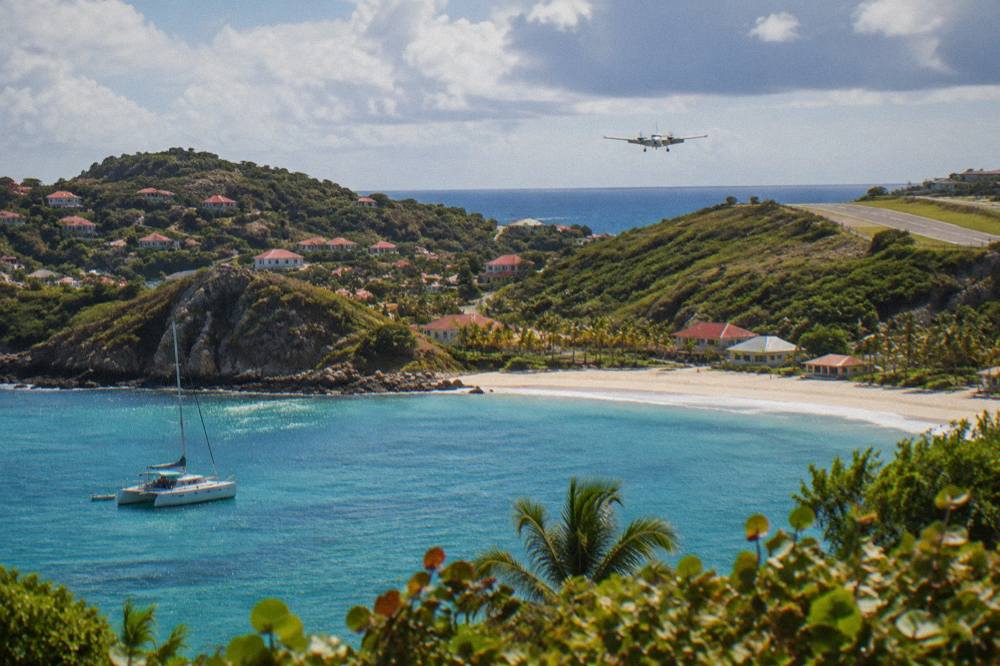
The overnight version turns the day trip into two, with a night at anchor off St Barts and a full second day on or around the island before the return crossing; the boat over option pairs naturally with a Saint-Jean afternoon of arrivals, since the mooring is a short hop from the airport side of the island.
A third charter worth knowing about, for groups who want a beach-club stop wired into the day rather than a snorkel bay, is the Nikki Beach private charter from Sint Maarten; it shares the same departure logic, Dutch side rather than French, with its own listing details.
What Else Should You Know Before A Plane Spotting Day In St Barts?
A spotting day at Saint-Jean needs only three things: daylight, a clear sky over the hill and somewhere to stand on public ground, and the rest of the island, from the harbor at Gustavia to the sunset shores, fills the hours between movements. Arrivals are free to watch, every beach is public, and the same daylight rule that ends the show each afternoon hands the evening over to the west-facing viewpoints.
Practicalities in brief. The island is about 21 square kilometres with roughly 10,700 residents, so nothing on it is far from anything else; a car or a Mini Moke from the airport counters at Avis, Budget or Hertz, or from a local agency, covers the whole circuit. Driving is on the right, the roads are narrow and steep, and the 50 km/h island limit drops to 30 km/h in Gustavia and Saint-Jean. The currency is the euro, French is the official language with English widely spoken, and entry is outside the Schengen area, so check your own government's travel advice for document rules rather than any summary. When the arrivals end, the guide to the best sunset spots in St Barts takes over where the runway leaves off, and the harbor page for Gustavia covers the tender boats and yachts that make the other kind of traffic this island is known for.
For a fuller read of what the island offers beyond the flight path, the roundup of things to do in St Barts on St Barthelemy Travel is the place to start, and the answer page on whether St Barts is one of the worst airports to land at settles the other half of the airport's reputation.
Common Questions About Watching Planes Land At St Barts
Can you watch planes land at St Barts for free?
Yes. The viewing spots at Saint-Jean, the public road shoulder at the runway end, the beach itself and the Col de la Tourmente road, are all public space, and every beach on St Barts is public. No tour, terrace or ticket is needed, and no guided walking tour of the airport area is listed here.
What planes land at St Barts airport?
Only small STOL turboprops, such as the DHC-6 Twin Otter, Cessna 208B Grand Caravan and Pilatus PC-12. The 646 m (2,119 ft) runway at Gustaf III Airport rules out jets entirely, and operations are daylight, visual-conditions only.
Where is the best place to watch the planes at St Jean?
The public road at the western end of the runway is the classic vantage, with arrivals passing directly over the traffic on short final. The airport end of Saint-Jean beach and the higher ground on the Col de la Tourmente road toward Gustavia give further views of the approach path.
Do planes land at St Barts at night?
No. The runway has no lighting, so the airport operates in daylight and visual conditions only, closing shortly after sunset. All arrivals happen between first light and late afternoon.
Which airlines fly into St Barts?
St Barth Commuter flies to SBH from St Martin (SXM), Grand Case (SFG) and Pointe-a-Pitre, Guadeloupe (PTP), and Tradewind flies in from San Juan (SJU) and Antigua (ANU). Winair flies the SXM to SBH hop on Twin Otters. No jet and no direct flight from outside the Caribbean lands on the island.
Can you combine the airport spotting with a boat trip?
Yes, though every bookable boat trip listed here departs from St Martin or Sint Maarten, never from St Barts. A group sail or private charter day with an island stop can be planned around an afternoon of arrivals at Saint-Jean, and the crossing alternatives are the ferries from Philipsburg and Marigot.