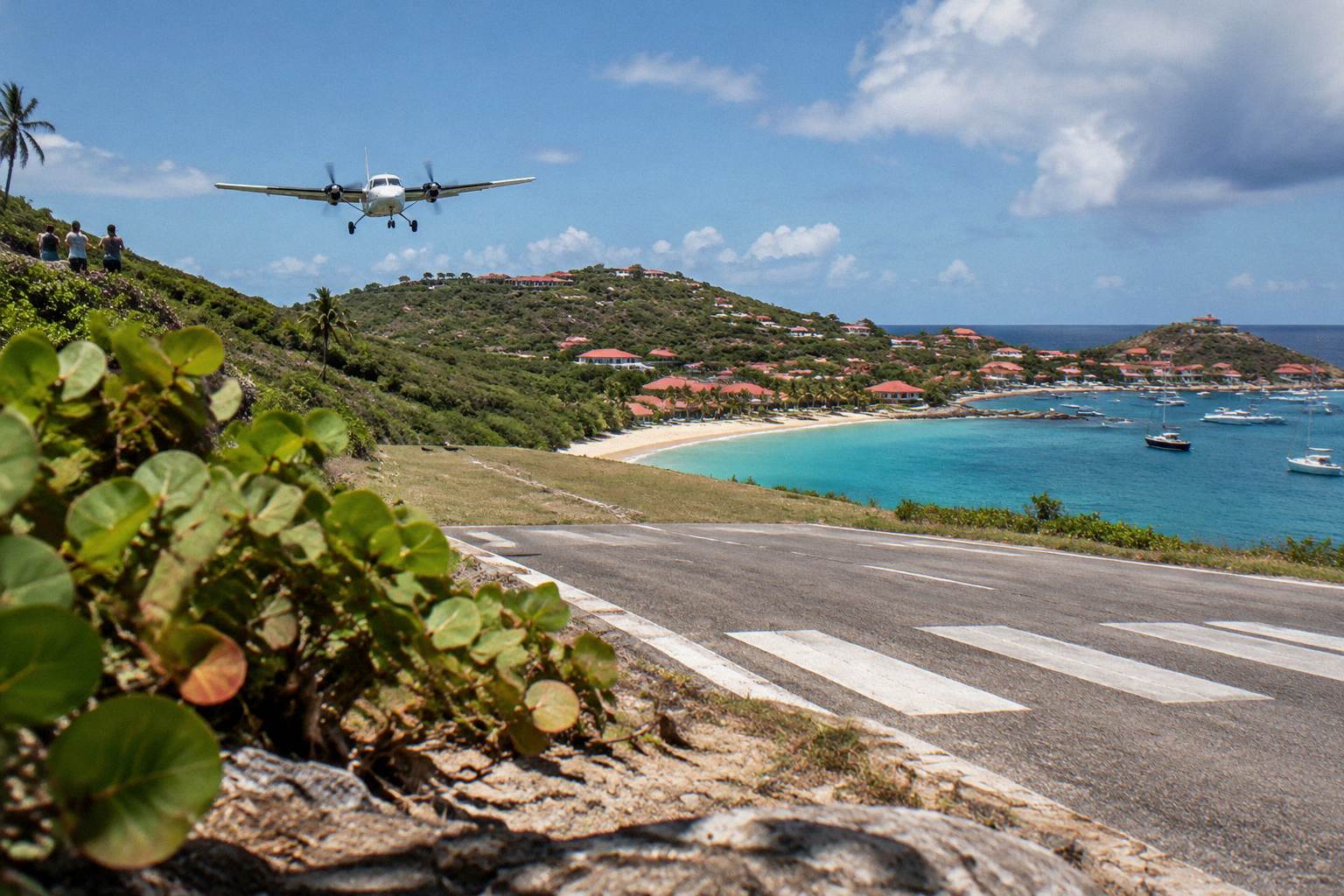
Is St Barts One Of The Worst Airports To Land At?
St Barts' Gustaf III Airport has a 646 m runway, no jets and daylight-only landings. Here is what that means for your flight and your alternatives.
St Barthelemy, usually written St Barts, is a small French island in the Caribbean with about 21 square kilometres of hills, public beaches and turquoise water. Its airport, Gustaf III, also called Remy de Haenen and coded SBH, regularly appears on lists of the world's most difficult or scariest airport approaches, and the reason is physical: a runway just 646 metres long, an approach that descends over a hill, and a rule that only small STOL turboprops may land there, in daylight and visual conditions only. Whether it deserves the word "worst" is a fairer question than the headlines suggest. For pilots it is demanding. For passengers it is a short, steep, spectacular hop, and for anyone who would rather skip it entirely there are two ferries from St Martin and a set of boat day trips that arrive in Gustavia harbour instead.
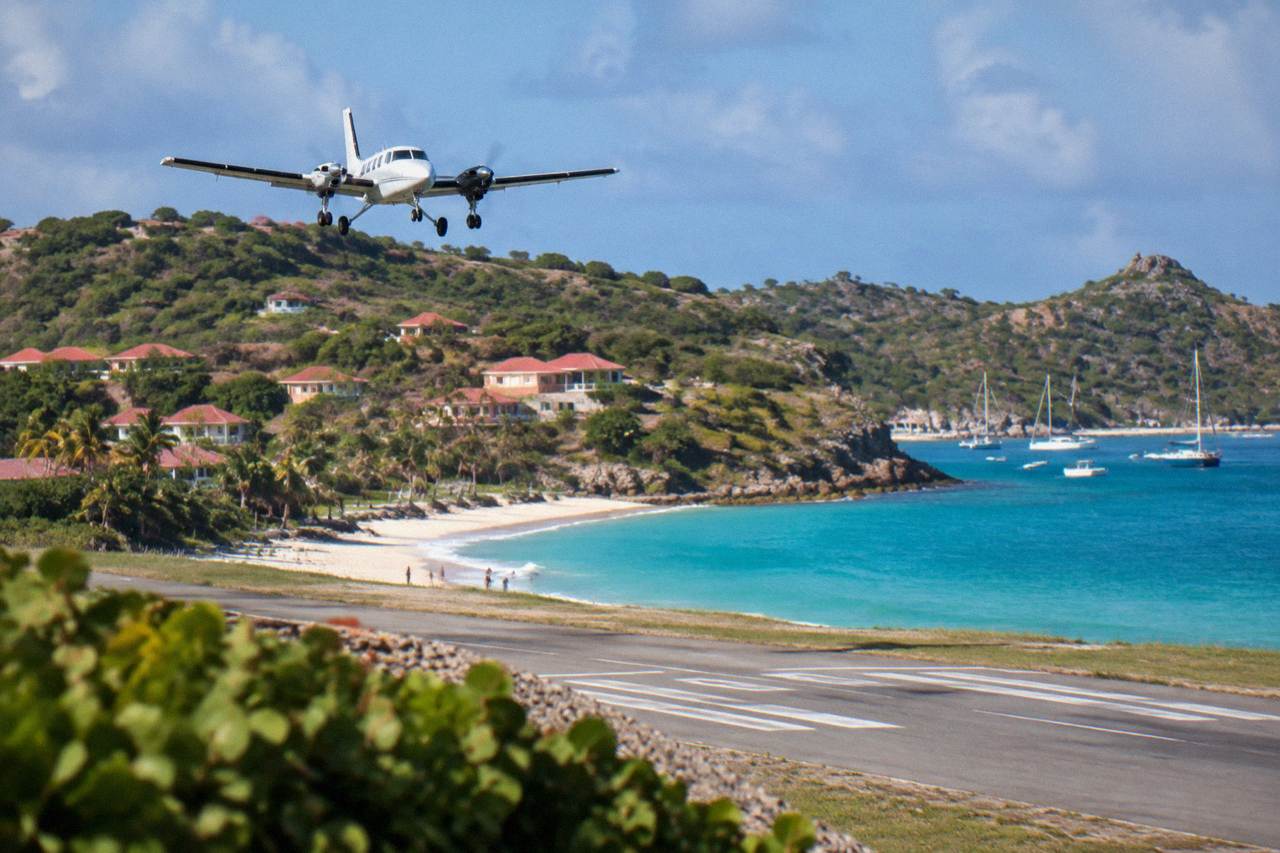
Gustaf III Airport is regularly described as one of the world's most challenging commercial airports, and the description is accurate from a pilot's perspective: the runway is 646 metres, the approach crosses a hill, only specially certified pilots may fly it, and operations stop at night and in poor visibility. For passengers, the landing is short, steep and over quickly, and "Worst" is a headline word, not an operational one.
The airport's reputation comes from geometry. The single runway, 10/28, measures 646 metres, or 2,119 feet, which is roughly a fifth of the length major international airports give their airliners. There are no runway lights: the airport opens in the morning and closes about fifteen minutes after sunset, and every flight must be flown by visual reference, which is why bad weather over St Barts means diversions back to St Martin rather than instrument approaches.
Pilots flying into SBH need special certification for the steep approach over the Col de la Tourmente and for short-field performance. Only STOL-rated aircraft are permitted, types such as the DHC-6 Twin Otter, the Pilatus PC-12 and the Cessna 208B Grand Caravan. That requirement is the strongest signal of difficulty: the regulator treats the airport as a specialist operation, not a routine one.
So the honest framing is two-sided. It is genuinely one of the more demanding airports a scheduled pilot can fly into. It is not, for the passenger in the back, the ordeal the listicles imply, and there are two well-established alternatives by sea if you would rather not fly it at all, which the section on ferries below covers.
Why Gustaf III Airport Accepts Only Small Turboprops
No jet of any size lands at St Barts. The 646 metre runway cannot accept one, so the airport is served exclusively by small STOL turboprops such as the Twin Otter and the Cessna Grand Caravan, flown by pilots holding a special qualification for the short, steep approach. Everything larger connects through gateways: St Martin, San Juan, Pointe-a-Pitre in Guadeloupe or Antigua, followed by a small plane or a ferry.
The carrier map is small and stable. St Barth Commuter flies to SBH from St Martin's Princess Juliana airport (SXM), from Grand Case on the French side (SFG) and from Pointe-a-Pitre (PTP). Tradewind Aviation flies from San Juan (SJU) and Antigua (ANU). Winair flies the SXM to SBH hop on Twin Otters. The hop from St Martin is short.
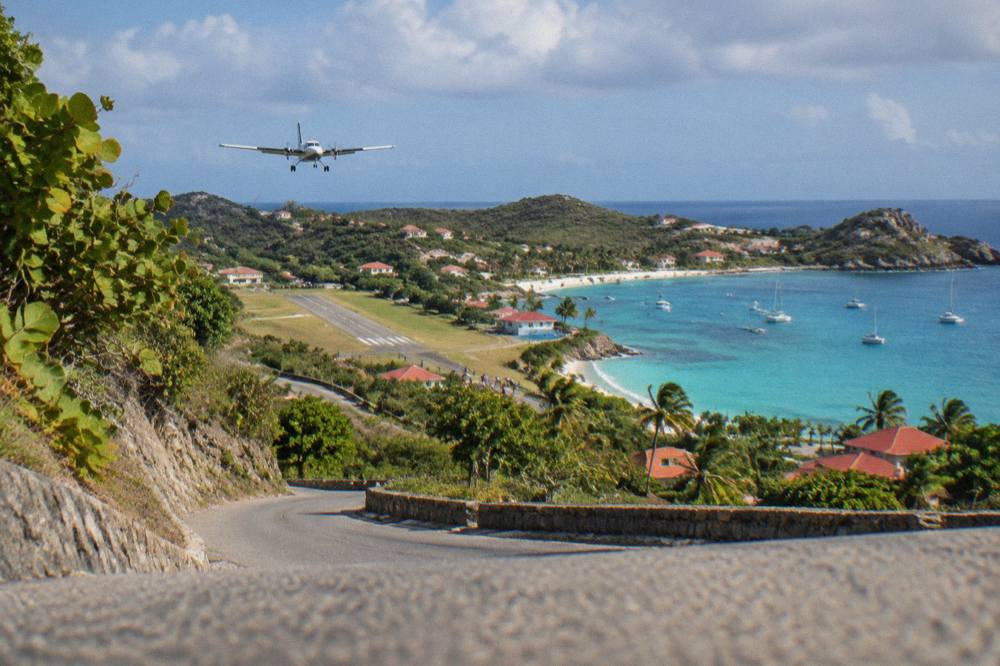
This is why the answer to "can you fly direct to St Barts" is always no from outside the Caribbean, a question covered in detail on which airports fly direct to St Barts. A traveller starting in the United States or Europe flies a jet into one of the gateways, then switches to a nine-seat turboprop for the final leg, or crosses by ferry. The airport's limits are, in a real sense, a policy outcome as much as an engineering one: the island has chosen to keep mass aviation out, the same way it keeps cruise ships small and tender-based in Gustavia.
| Constraint at SBH | What it means in practice |
|---|---|
| Runway 646 m (2,119 ft) | Only STOL turboprops; no jets, ever |
| Approach over Col de la Tourmente | Pilots need a special certification |
| No runway lights | Daylight operations only, closing after sunset |
| Visual conditions only | Poor visibility means diversion to St Martin |
| Maximum aircraft types | Twin Otter, PC-12, Grand Caravan class |
What The Landing At St Barts Feels Like From The Cabin
The approach descends over a hill, levels late and touches down quickly, with braking felt almost immediately and the beach of Saint-Jean visible off the wing for much of the descent. It lasts moments, not minutes, because the aircraft involved are small and the hop from St Martin is short. Seat-of-the-pants descriptions vary widely and no survey exists, so this page prints the geometry, not the adjectives.
The descent is the famous part. The aircraft crosses the headland, drops steeply over the road at Col de la Tourmente and arrives over the threshold with little room to spare. From the right side of the cabin the slope of the hill fills the window; from the left, Saint-Jean beach and its lagoon sit close below. Passengers who enjoy it book window seats on purpose, and St Barts airport spotting has become an attraction in its own right, with people watching arrivals from the road and the beach near the threshold.
A few practical notes follow from the equipment. Small aircraft mean tight weight limits, so baggage allowances are stricter than on the feeder jet and it is worth checking the operator's rules before packing. Weather diversions happen: a flight that cannot make visual contact goes back to St Martin and tries again or waits. Building a buffer into any connection, especially an outbound one, costs little and removes most of the stress the airport's reputation creates.
How To Skip The Landing Entirely: Ferries From St Martin
Two ferry operators connect St Martin and Sint Maarten with Gustavia: Great Bay Express from Bobby's Marina in Philipsburg, about 45 minutes on the water, and Voyager from the Marigot terminal on the French side, about 50 to 60 minutes. Both run roughly two to three crossings a day in each direction, subject to weather and season, and the crossing can be rough. For fares and timetables, the operators' own booking pages carry live times.
The ferry is the standard answer for travellers who would rather not fly the approach, and it doubles as the practical fallback when weather grounds the planes. Great Bay Express departs from the Dutch side, Philipsburg, and Voyager from the French side, Marigot, so the right one depends on where you are staying before the crossing. The operator's ferry page asks passengers to arrive well before departure with a passport, and check-in closes shortly before sailing.
One honest caveat: the sea between the islands is open water and the passage is not promised smooth. The page on getting to St Barts covers seasickness planning in detail. If a rough crossing is a dealbreaker in both directions, a private boat transfer or a day-trip charter from St Martin lets you arrive the same way, with the airport's hill as scenery rather than an obstacle.
Charters are the third door. Every boat product listed here departs from St Martin or Sint Maarten and visits St Barts, never the reverse, so the airport never enters the itinerary at all.
What To Do On St Barts Once You Have Arrived
The island rewards the effort of getting there with about a dozen public beaches, a walkable harbour capital in Gustavia, and a marine reserve whose rules, a 5 knot speed limit in protected zones, a ban on jet skis and a no-touch rule for turtles, are set by the environment agency. The runway difficulty fades quickly once you are on the sand, and the same geography that makes the airport hard makes the coastline what it is.
Gustavia itself is the natural first stop: red roofs around a working harbour where superyachts and tenders share the anchorage. There is no cruise pier, so visiting ships anchor offshore and ferry passengers in by tender, which keeps the town's scale human even on busy days. From the harbour, the beaches ring the island: Saint-Jean, Gouverneur, Saline, Flamands, Colombier, Grand Cul-de-Sac, Lorient and Shell Beach among them, all public.
The marine reserve shapes what happens on the water. The environment agency's regulatory-zones page lists a 5 knot limit inside its zones, a prohibition on jet skis and other motorised water toys, a no-dogs rule on reserve beaches and a strict ban on touching turtles, with green and hawksbill turtles present around Colombier and in the Grand Cul-de-Sac lagoon. Snorkellers and sailors operate inside those rules, which is one reason the boat day trips from St Martin are built around slow, anchored stops rather than high-speed circuits.
Planning the days themselves is easier with a route already drawn: the St Barts one week itinerary strings the beaches and the harbour into a realistic shape, and St Barthelemy Travel covers every corner of the island in depth.
Arriving By Boat Instead: The View From The Water
A day trip from St Martin reaches Gustavia, Colombier Beach and Ile Fourchue in one loop, and the group sail listed here runs only from 12 May to 31 August 2027 on its listing, with the rest of the trip list made up of private charters priced per group. Every one of them departs from St Martin or Sint Maarten. From the deck, the airport's hill and runway are simply part of the coastline.
The group sail is the entry point for solo travellers and couples who do not want to charter a whole boat: a day on the water with snorkel stops at Colombier and Ile Fourchue, both inside the reserve's protected zones, and time in Gustavia itself. Its seasonal window, 12 May to 31 August 2027 on its listing, is a real constraint to plan around, since the rest of the year the trip list is private-only. The sailing day is also, quietly, the best answer to this page's question: the airport that headlines "worst in the world" lists becomes a strip of coral and green on the hillside, watched from a mooring buoy rather than a window seat.
For a longer version, the overnight private catamaran option from St Martin turns the crossing into two days with a night at anchor, and the full day private charter page details the per-group format the trip list uses throughout.
Common Questions About Landing At St Barts
Is St Barts One Of The Worst Airports To Land At?
For pilots it is among the more demanding commercial airports: a 646 metre runway, a steep approach over a hill, special pilot certification and daylight-only, visual-only operations. For passengers it is a short, dramatic hop in a small aircraft, not an ordeal. The "worst" label is a headline judgement, not a safety finding.
Do jets land at St Barts?
No. The runway at Gustaf III Airport is 646 metres long and only small STOL turboprops are permitted, in daylight and visual conditions. Travellers arriving on jets connect through St Martin, San Juan, Pointe-a-Pitre or Antigua.
Which airlines fly into St Barts?
St Barth Commuter flies from St Martin (SXM), Grand Case (SFG) and Pointe-a-Pitre (PTP); Tradewind flies from San Juan (SJU) and Antigua (ANU). Winair flies the SXM to SBH hop on Twin Otters.
Can I avoid flying into St Barts altogether?
Yes. Two ferries connect the neighbouring island with Gustavia: Great Bay Express from Philipsburg and Voyager from Marigot. Private boat transfers and day-trip charters from St Martin are further alternatives, and every boat tour on this site departs from St Martin or Sint Maarten.
Is the flight from St Martin to St Barts dangerous?
The route is flown by specially certified pilots in aircraft designed for short fields, under visual rules that stop operations in poor conditions and divert flights back to St Martin when needed. The airport's difficulty is a matter of certification and procedure, and both are strict.