Is There A Time Difference In Saint Barts?
St Barthelemy keeps Atlantic Standard Time, UTC minus 4, all year with no daylight saving. Here is how the island's clocks compare with the US, Europe and its neighbors.
St Barthelemy, the small French island in the Caribbean usually written St Barts, keeps one of the simplest clock arrangements in the travel world: it sits at UTC minus 4 and never changes it. There is no spring forward, no fall back, no daylight saving of any kind. The island uses Atlantic Standard Time in July exactly as it does in January, which means the time difference you feel depends almost entirely on your home country and the season in which you fly. For anyone arriving through St Barthelemy Travel planning resources, the clock is the easy part of the trip.
Yes, for nearly everyone except the island's neighbors: St Barts runs on UTC minus 4, Atlantic Standard Time, all year with no daylight saving, so it is one hour ahead of New York in winter, level with New York in summer, and four to six hours behind Western Europe depending on the season. Travelers from mainland France, the UK and most of the US will feel a shift, while arrivals from St Martin, Guadeloupe and Puerto Rico for much of the year will not.
The island's time zone, UTC minus 4 with no daylight saving observed, is a fixed administrative fact of this French overseas collectivity, and it does not shift with the seasons. That single detail is what makes the answer to this question a moving target for travelers rather than a fixed number. A visitor from Boston experiences one hour of difference in February and zero in June, not because St Barts moved, but because Boston did.
The practical effect is gentle by long-haul standards. A five or six hour offset from Paris or London is real but manageable, and the island's tropical rhythm, with the Meteo-France normals showing mean daily highs from 28.5 C in January to 31.7 C in September, tends to push visitors outdoors and into daylight early regardless of their home clock. The equatorial-ish daylight pattern matters too: at this latitude the sun rises and sets within a fairly narrow band all year, so 7 a.m. looks roughly like 7 a.m. in every month.
What Time Zone Is St Barts On Compared To The United States?
St Barts shares its clock with Puerto Rico and the US Virgin Islands, Atlantic Standard Time at UTC minus 4, so in summer it matches the US East Coast exactly, while in winter it runs one hour ahead of New York, three ahead of Chicago and four ahead of Los Angeles. US travelers lose or gain nothing in summer, and in winter the island is simply one hour ahead of the Eastern seaboard.
The reason is the daylight saving asymmetry. The US mainland changes its clocks in March and November, moving between Eastern Time at UTC minus 5 in winter and UTC minus 4 in summer. St Barts stays put at UTC minus 4 forever. So the offset between New York and Gustavia flips between one hour and zero twice a year, while the offsets from Chicago and Los Angeles shift between two and one, and three and four respectively.
| Departure city | Offset in northern winter (roughly Nov to Mar) | Offset in northern summer (roughly Mar to Nov) |
|---|---|---|
| New York | St Barts 1 hour ahead | Same time |
| Miami | St Barts 1 hour ahead | Same time |
| Chicago | St Barts 2 hours ahead | St Barts 1 hour ahead |
| Los Angeles | St Barts 4 hours ahead | St Barts 3 hours ahead |
| San Juan, Puerto Rico | Same time all year | Same time all year |
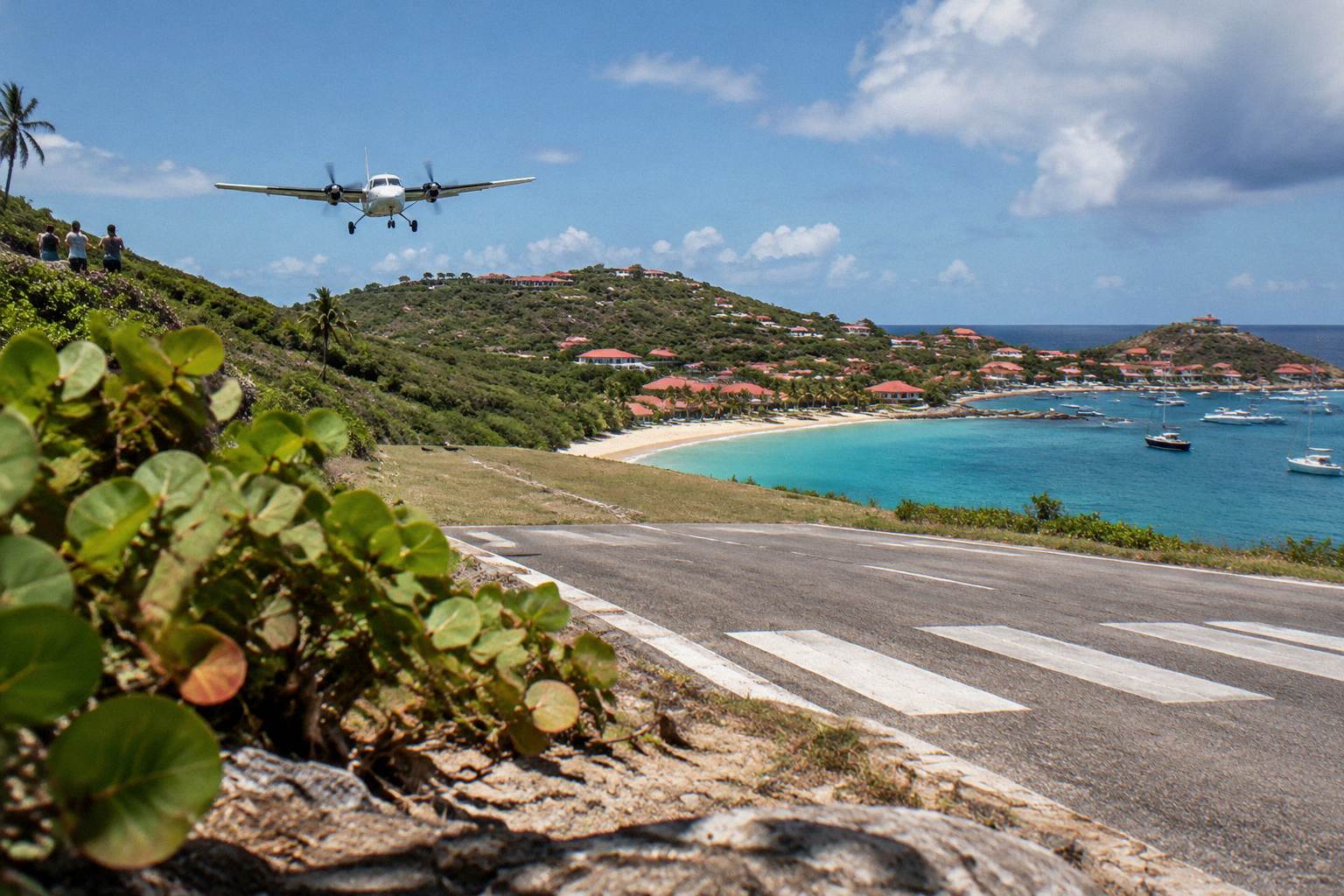
For flight planning, this cuts both ways. Because the island's airport, Gustaf III, accepts only small turboprops in daylight and visual conditions, arrivals from the US funnel through gateways such as St Martin, San Juan, Guadeloupe or Antigua, then finish with a short hop or a ferry. The clock arithmetic is small; the connection logic is the part that deserves attention. More on the routing is covered in flying to St Barts from the US.
Travelers often ask whether the same clock logic applies to the Dutch and French sides of the neighboring island. It does: St Martin and Sint Maarten keep the same UTC minus 4 as St Barts, so a ferry passenger never changes time zones on the crossing. The comparison between the two islands is covered separately in St Barts versus St Martin.
How Many Hours Behind Europe Is St Barts?
St Barts runs four hours behind the UK in the British winter and five behind during British summer time, and five to six hours behind Paris depending on the season, because Europe changes its clocks while the island does not. A 2 p.m. departure from Paris lands the traveler in a local afternoon or evening, and the return leg, eastbound, is where the longer adjustment sits.
The asymmetry again comes from daylight saving, this time Europe's. Mainland France sits at UTC plus 1 in winter and UTC plus 2 in summer; the UK sits one hour behind France in both seasons. St Barts, fixed at UTC minus 4, therefore sits five hours behind Paris from late October to late March and six hours behind from late March to late October. The UK gap runs one hour smaller in each case.
| Reference city | St Barts offset, European winter | St Barts offset, European summer |
|---|---|---|
| London | 4 hours behind | 5 hours behind |
| Paris | 5 hours behind | 6 hours behind |
| Amsterdam | 5 hours behind | 6 hours behind |
| Zurich | 5 hours behind | 6 hours behind |
Mainland France travelers should also remember the administrative wrinkle that has nothing to do with clocks: St Barthelemy is outside the Schengen area, so a Schengen visa or ID arrangement does not by itself settle entry, and the entry rules follow French overseas regulations rather than mainland ones. Passport and entry questions are handled in detail at do US citizens need a passport for St Barts, and the fuller zone explanation sits on the St Barts time zone guide.
A useful mental model for European visitors: think of St Barts as five or six hours behind your watch, but treat sunset as arriving early. At this latitude darkness falls in the early evening year-round, and much of the island's social life, particularly around the harbor in Gustavia, shifts accordingly. Weather context for planning the daylight hours is in what the weather is like in Saint Barts.
Does St Barts Use Daylight Saving Time?
No, St Barts observes no daylight saving time at all, holding UTC minus 4 in every month of every year, which is why its offset against New York, London and Paris swings twice a year while its offset against Puerto Rico, Guadeloupe and St Martin never moves. The island's sunrise and sunset times also barely shift across the calendar, unlike at higher latitudes.
This stability is common across much of the Caribbean and it simplifies two things. First, scheduling: a ferry or flight connection timed in local hours means the same thing in April as in October. Second, sunrise logic: because the island sits near the tropics, its daylight window stays within a narrow band all year, so an early flight or a morning boat departure happens in similar light whenever it is booked. The airport's daylight-only operation makes that consistency genuinely operational rather than merely pleasant, since the flying day is bounded by the sun itself.
The wider seasonal context matters for anyone scheduling around events. The island's calendar is anchored in local time regardless of what clocks say elsewhere: the Gourmet Festival runs 9 to 15 November 2026, the Music Festival runs 8 to 18 January 2027, and the Bucket Regatta falls in mid-March. A first visit planned around any of these is well served by the St Barts first-timer itinerary.
Does The Time Difference Affect Tours And Day Trips To St Barts?
In practice barely: every bookable boat tour listed here departs from St Martin or Sint Maarten, which keeps the same UTC minus 4 clock as St Barts, so day-trippers cross no time zones at all, while fly-in visitors from the US East Coast face at most a one hour shift and Europeans a five to six hour one. The clock is a minor factor next to the daylight window, which sets when boats leave and return.
Because the departure ports, on either side of the neighboring island, share the island's time zone, a day trip to Gustavia, Colombier Beach or Ile Fourchue is scheduled entirely on one clock. The departure is set for the morning light, the return for the late afternoon, and no one aboard resets a watch. The one per-person group sail listed here, the Boomerangs sail and snorkel to Gustavia, Colombier and Ile Fourchue, runs on that single-clock basis, and its seasonal window, 12 May to 31 August 2027 on its listing, sits squarely in the northern summer when East Coast visitors share the island's exact hour.
Private charters follow the same logic. An eight hour private charter day from St Martin is bookable for a fixed stretch of daylight on one time zone, and the two day one night private catamaran spends its overnight in St Barts waters with no zone change at any point. Scheduling anxiety about calling home, checking in with a hotel, or catching a return flight from SXM on the Dutch side is therefore minimal: the whole corridor from Philipsburg or Marigot to Gustavia lives at UTC minus 4.
For visitors combining the islands, the practical timezone-free corridor extends to trip design. Whether to spend nights on St Martin before or after the St Barts leg, and what to do with them, is laid out in things to do in St Barts.
How Do Travelers Handle Jet Lag Arriving In St Barts?
Eastbound travelers feel the offset most, since St Barts sits four to six hours behind Western Europe, meaning Paris travelers land with their body clock insisting it is late evening while the island sun says afternoon, while US East Coast visitors face at most one hour and West Coast visitors three to four, which usually dissolves within a day or two of normal island routines.
The westbound-then-stop pattern of a European trip to St Barts is the classic case: a morning departure from Paris with a connection through St Martin or San Juan puts the arrival in bright Caribbean daylight against a body clock reading early night. The standard advice follows from the island's own rhythm. Daylight exposure early, an early dinner, and an early night align the body clock within a day or two, helped by the fact that tropical darkness falls early and consistently, cueing sleep at an hour that feels natural on island time.
US travelers have an easier version of the same process. A one hour shift is barely noticeable, and even the four hour Los Angeles gap usually resolves inside two days. The heavier burden for American visitors is not the clock but the logistics of the last leg: the small turboprop hop or the roughly 45 minute to one hour ferry crossing from the neighboring island, both of which are daylight-bound and weather-sensitive in ways no time zone table captures. The natural constraints of that final stretch are part of why it is hard to get to St Barts and are a reason many travelers build a buffer night on St Martin.
Two small habits do most of the work. Set the phone's clock to local time on landing rather than mid-journey, so the day's remaining decisions are made against the island's clock; and schedule nothing time-critical for the first afternoon, since a beach, a swim and an early dinner handle the adjustment better than a checklist. For those who want a slow first day mapped out, the St Barts first-timer itinerary opens with exactly that kind of easing-in structure.
Common Questions About The St Barts Time Difference
Is There A Time Difference In Saint Barts?
Yes if you come from anywhere outside the UTC minus 4 zone: St Barts keeps Atlantic Standard Time, UTC minus 4, all year with no daylight saving, so it is one hour ahead of New York in winter and level with it in summer, and five to six hours behind Paris depending on the season.
Is St Barts the same time as New York?
In summer, yes, exactly, because New York moves to UTC minus 4 for daylight saving while St Barts stays there permanently. In winter New York falls back to UTC minus 5 and St Barts is one hour ahead.
Is St Barts the same time as St Martin and Sint Maarten?
Yes, both sides of the neighboring island and St Barts itself share UTC minus 4 with no daylight saving, so ferry and flight connections across the corridor never involve a clock change.
Does St Barts have daylight saving time?
No. The island observes UTC minus 4 in every month of the year. All seasonal changes in the time difference come from the traveler's home country changing its clocks, not from St Barts.
How many hours behind London is St Barts?
Four hours behind London during the British winter and five hours behind during British summer time, because the UK observes daylight saving and St Barts does not.
The clock, in short, is the least complicated part of reaching St Barthelemy: one fixed zone, no seasonal change, and neighbors that share it. The parts that deserve the planning attention are the daylight-bound last leg and the seasonal shape of the island itself, both of which reward a slow first day and an early night on arrival.